
Patsey's Dolls: Why We Must Create

Why we must create.
The one scene that I keep going back to again and again from 12 Years a Slave is where we see Patsey crafting her corn husk dolls.
This scene struck me because it bores down to the essence of who we are as women, creators.
Our need to create, to connect, and to release our spirit is greater than any injustice, pain, or sorrow we have or will ever endure.
We create to be free.
Our creations are what frees us. When discussing Patsey and the corn husk dolls, Lupita Nyong’o stated that, "In playing her, I learned that you don't have to live a day free to know what freedom is." (Interview, 11/20/2013)
For that period of time, Patsey was free and present in that freedom. In those moments she was not enslaved, nor someone’s mule or sexual satisfaction.
I imagine she also created freedom for others by giving the dolls to the girls on the plantation, teaching others to make the dolls, or inspiring them to create something of their own.
We must create our art for the sake of freedom.
We create to save ourselves.
Our creations are what save us.
They save us from insanity and nothingness.
They nourish us and keep us whole.
They have kept us alive and it is what allows us thrive against all odds.
To create is to be courageous. To fly in the face of doubt.
To dare to be the greatest thing you can be, yourself.
We create to feel.
When we are creating, a light opens up inside and makes our pearly, peachy, cafe con leche, golden, cacao and obsidian skins radiate.
The rhythm in our hips and steps becomes hypnotic.
Our voices drift like a sweet summer breeze and boom like the night thunder.
Divine gifts are produced from our hearts, minds, tongues, hands and wombs.
Dreams become songs and paintings.
Feelings grow into flowerbeds and quilts.
These creations flow out like blood, sweat and tears, freely, but not without sacrifice.
We are artists.
We are artists in every sense of the word.
Whether we are braiding hair, birthing babies, organizing, growing a garden, painting our bodies, resisting, or “making a dollar outta 15 cents”, we manage to infuse our souls.
Each of us has our own corn husk doll waiting to be birthed from the part of us that cannot be adulterated.
We say to the world, “because I have created this, you cannot deny my existence.” Though, they will try.
It’s reminder that we are (and were) here and not to forget us.
Creating is the art of being.
This is why we must create.
Why do you create?
Creative Self-Care: An Overview
What is creative self-care?
Creative self-care is a term growing in popularity among self-improvement circles and is a type of self-care.
Self care is doing things that you keep you happy and healthy.
Creative self-care takes that one step further by encouraging artistic and imaginative expression as a way to practice self-care.
Creative self-care hits the reset button on your mind, body and soul and facilitates self-expression at the deepest levels.
Creative self-care is for everybody. We all need to restore ourselves living in this chaotic world.
With the increasing presence of technology in our lives, more demand is placed on our attention in addition to our families, partners, career and other obligations.
As a nation, we are overworked, overstressed and the rate of disease proves that we are not properly taking care of ourselves.
The creative component is special because it calls on a part of us that we may have neglected since we were younger.
We all have creativity within us. It is how we survived as a species for tens of thousands of years. Evolution, natural instinct, intuition and creativity are all synonyms to me.
What are the main components of creative self-care?
The main areas of creative self-care that I promote are meditation, movement, creation, intuition, and play. Every person needs a prescription for more of these.
Meditation
Everyone should be meditating. Seriously.

Even if you are the most fidgety person in the world you should meditate because the benefits are a no-brainer.
When you think of meditation you probably imagine someone sitting crossed-legged a.k.a. lotus position and chanting “om”.
That is the commonly accepted image of meditation, but that is by no means required.
You can sit in a chair, sit with your legs straight out in front of you, or lay down. You can chant out loud or in your head. You can repeat a mantra or count numbers. You can also just focus on your own breath.
Prepare for your mind to be blown in a second. Ready?
You don’t even have to do any of the above.
You can do writing meditations, listen to music that is soothing to you, or drink a cup of tea.
All meditation requires is that you focus your mind on the moment at the bare minimum.
This is why I promote creative self-care because while you are painting or journaling, your mind is focused on that task. You’re essentially meditating and creating at the same time.
Movement
Your mind is integrated with your body and they influence each other.
You can use your mind to motivate your body to do something. Moving your body can also change your mental state.
Furthermore, movement helps you maintain and improve your physical health. Yoga is my favorite source of movement.
I like yoga and it's my preferred form of exercise. Anyone can do yoga. Yoga doesn’t require you to be flexible, thin, or whatever you may think doing yoga looks like. Yoga and meditation are two peas in a creative self-care pod.
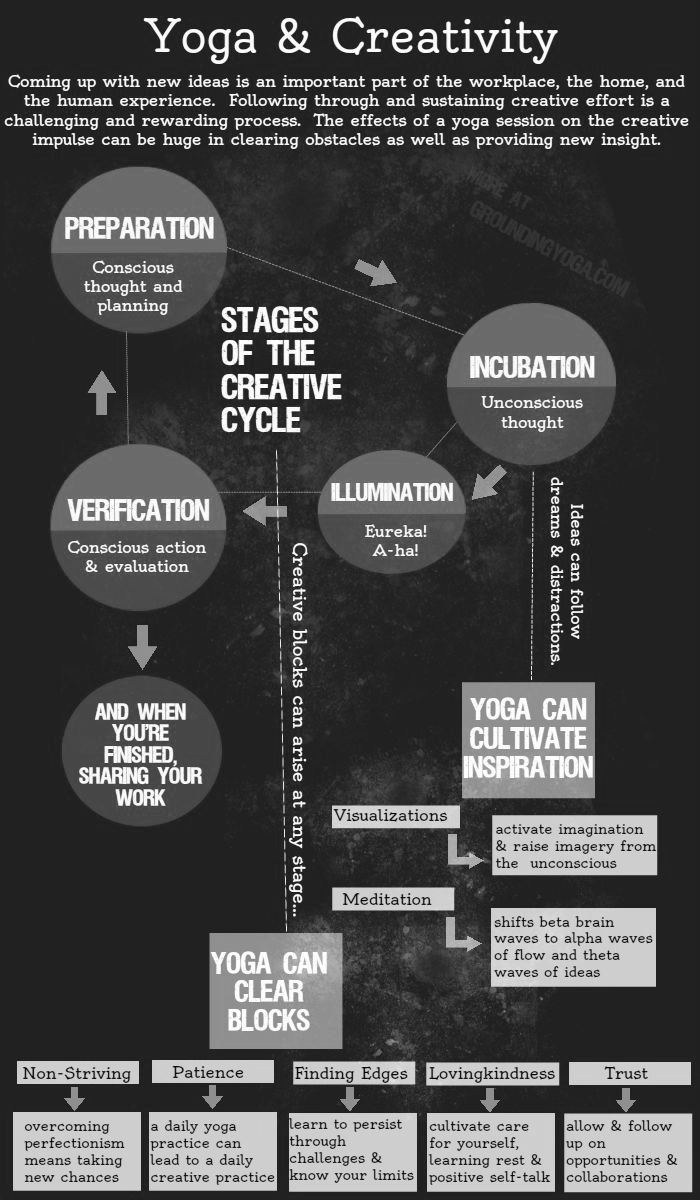
Like meditation, yoga asks you to focus your mind with the added element of your body. It’s mindful movement and any person can improve their inner state with it.
While I practice and encourage yoga, the simplest form of exercise is walking. According to a Stanford study, taking a walk can increase creative thinking by up to 60%.
Also, you can achieve the same mental boost from walking outside or walking on a treadmill. You can walk however you like as long as you do it for at least 5 minutes.
Regardless of how you choose to move, just do it. It's great for you mental and physical health.
Creation
A key element of creative self-care is the creativity part. The fruits of your self-care reveal your inner self.
This is where you can explore your feelings, fantasies, goals and dreams and produce something tangible that represents your world.
The physical creations include vision boards, paintings, doodles, poems or journal entries.
If you’re a left-brainer, you can also express your creativity through mind maps and other organizational visuals.
Writing is an easy way to start expressing yourself. I think it’s also the most natural form of expression for us because words are such an integral part of human communication.
Journaling is my favorite creative self-care activity. I do it almost daily for my personal life and business. Journaling about your experiences can help you heal from emotional and physical traumas more quickly.
Free writing helps you create and find solutions, bring forth latent ideas, remove brain clutter and tap into your intuition.
Play
This may be the best part of creative self-care. You will need to call on your inner child and let her run wild. Climb trees, jump rope, build a fort, or play hide-and-go-seek.
Make a list of all the fun things you used to do as a kid and do them. Adult games are fun too.
Playing releases your mind from the stresses of adult life, helps you be more imaginative, and look at things from a different perspective.
Intuition
Accessing your inner knowing and being aligned is the underlying point of all this. It’s how we find our purpose which is why we’re here on this earth.
Intuition is called gut feeling, instinct, magic, signs from the universe and God's voice. Intuition is all of those things.
Your intuition is the spiritual being that resides in your physical body and guides you on your journey. Whatever you call it, we’ve all been in situations where we just knew something was wrong or we were confident that a choice was right, but could not explain it in logical terms.
Every experience that you go through happens for a reason and is teaching you a lesson on your journey. All you have to do is accept responsibility and examine your experience to find the truth.
When and where can creative self-care be practiced?
Creative self-care can be practiced on a daily basis, but if you can’t practice daily at least find time for weekly “me time”.
Ideally, creative self-care is practiced whenever and wherever you are available.
To make creative self-care a daily or weekly routine you have to examine your schedule to see where you can find the time.
Start with at least 5 minutes and work your way up from there. Practice when you wake up in the morning or before you go to bed at night.
It also doesn’t have to be a delegated time you’ve set aside. Doodle and journal during the inevitable work meetings you find yourself in. You may just come up with a solution to the problem your team has been working on.
Take your 15 minute break and do 5 minutes of journaling, 5 minutes of yoga, and 5 minutes of meditation.
Don’t overlook those times throughout your day where you have downtime. Turn your laptop, phone and tablet off or put them to sleep while you practice.
I also recommend practicing nature. The beauty of nature is enough to inspire anybody. A park, the beach, a small clearing in the woods, your garden, or the porch of your home.
Within your home, there may be a room you’ve reserved for “me time”, or even a corner in your bedroom or living room will work.
Wherever you can find the time and space, do your best to focus your attention and energy on your creative self-care practice.
Whether you engage in creative self-care or regular self-care, the important thing is that you make time for you.
Sources and Further Research
- http://www.cdc.gov/niosh/programs/workorg/risks.html
- http://www.ncbi.nlm.nih.gov/pmc/articles/PMC3341916/
- Meditation Infographic: http://www.huffingtonpost.com/2014/05/14/meditation-mind-body-spirit_n_5291361.html
- http://www.psychologytoday.com/blog/tracking-wonder/201211/the-science-creative-insight-yoga
- Yoga Infographic: http://groundingyoga.com/2013/04/27/can-yoga-make-us-more-confident-and-creative/
- http://apt.rcpsych.org/content/11/5/338.full
What are you favorite creative self-care activities?
Creativepreneurs: Kathryn Buford
Kathryn Buford is the co-founder of Live Unchained.
I met Kathryn Buford around 2006 when I was a student at UIUC.
I have had the pleasure of following her journey and creation of Live Unchained, a site that highlights women artists across the African Diaspora.
Being one of the sweetest people I know, Kathryn graciously agreed to be interviewed about her art, inspiration and creativity.
What type of artist are you and what is your creative work?
I'm a writer, curator and entrepreneur -- I consider all of these arts.
How would you describe your inner artist?
I would describe her as communal. She most comes alive from the support of kindred spirits. Even if I'm not working directly with someone on a project, just sharing my ideas and getting encouragement to take risks inspires me to create.
How do you prepare to do your creative work?
It's a mix - there's no standard formula for me. I've learned to love the experience of a good creative flood where ideas just come rushing in, I get tingly and have to write on whatever used computer paper, napkin or receipt is nearby. The thing with this is, in the moment you feel confident, but later on, you can second guess yourself. When I prepare to do work after an episode like this, I get really easy on myself and recognize that I may not use it, I may have to tweak it, but I'm going to at least acknowledge it.
More recently, I've just started to think more strategically about what do I want this article or event to communicate and what's the best timing.
What does it feel like when you’re in the groove with your work?
Effortless.
What do you hope to inspire or accomplish with your work?
I hope to show that you don't need to come from a certain background or have been well-connected to be a successful artist. I want to show people that with the right outlook and strategy you can realize your highest creative self. It certainly takes more than affirmations and positive thinking - though that is essential - it's about understanding the field in which you work so you can master it.
Will Smith once said, "It doesn't matter how talented you are, if you're not skilled, your talents will fail you." What I wanted to accomplish with Live Unchained, where we've feature more than 100 interviews with artists from over 16 countries, is show that even accomplished artists are still grinding, honing all types of skills - people skills, interpersonal skills and trying to be better people.
We focused on black women because I wanted to be an intervention in the media. Too often, dominant representations don't reflect the diversity of our perspectives, experiences and even nations we come from and languages we speak.
What artists have influenced you?
Every artist I've featured on www.liveunchained.com. I think the reason people respect us so much is because our sincerity shines through. We've only featured artists who truly resonate with us.
Do you have a tribe? Who are they and what do they look like?
I'm definitely an inter-tribal woman. But, currently I feel drawn to the tribe of quiet doers. I have slowed down output with Live Unchained to work on the next direction we'll take with our recent grant and from new funders. I'm taking my time, thinking things through with my team and getting things in order for a solid re-launch. I say all that to say this tribe of mine is made of the people who know you don't need to peak to soon and don't just want to take pleasure in having accomplished dreams, but in the journey to realize them. We are the people with active goals, we don't dream of having done something, but doing it with visionaries that are just as committed. We know we don't have to choose between the two, but we'd rather play the long game and be relevant than have instant success and be popular.
What are your dreams and goals?
One of my favorite media experts, Ryan Holiday, is also my new favorite philosopher. His thinking on work and life is simple: "Be a good person. Love what you do." The big dream and only goal is to be able to do the good I want through my writing, curation of exhibition and events and any collaborations life wants to surprise me with. I want to love what I do so it doesn't feel like work until the check comes in and I realize how well-compensated I am.
I've already lived out my dreams of working with friends and interviewing artists, activists and intellectuals who inspire me. I'd really like more of that on a greater level - working more closely with the mentors who have become my friends and more interviews. I just want to get better and better at my craft, I want to be put in positions to learn as much as I can.

How do you practice self-care?
I have a life coach whom I love. Whenever I reach a roadblock she helps me think of ways to rethink the situation and move forward. I consider meeting with her, someone who has my best interest and success at heart, with no judgement or agenda, a form of self-care.
What does spirituality mean to you and how important is it in your life?
I think spirituality is the practice of honoring your spirit. It's essential everyday because it's how I protect myself from doubt and criticism - whether it's coming from me or someone else. Recognizing that my soul is all peaceful, has infinite knowledge and can never be harmed helps me remember that whatever challenge that's going on in front of me isn't all that's going on.
What advice would you give women trying to discover their inner artists?
This is an interesting question because it reminds me of how I answer the question: "What does it mean to Live Unchained?" To me living unchained means having nothing to prove and nothing to hide.
My advice to someone on the creative journey is this: Don't worry about impressing people with your uniqueness, rich friends, snarky wit or number of Instagram followers. Always do your best in creating and marketing your art - if you have to market it yourself step up to the challenge and learn how to do it well. If you want a meaningful career, this is a marathon not a sprint - take the time to hone your skills. Don't compromise your integrity for fame. When you make a mistake, forgive yourself as quickly and completely as possible. You have nothing to prove and nothing to hide.
Connect with Kathryn Buford and Live Unchained.
My favorite quote was, "When you make a mistake, forgive yourself as quickly and completely as possible. You have nothing to prove and nothing to hide." What was yours?
Check out more interviews.
30 Days to Digital Declutter
Digital Declutter Challenge
The new year signals a time to get rid of the old and make room for the new, but one area we may overlook is our digital life. Cleaning up your digital world is just as satisfying and beneficial as cleaning out your closet.
To make this easy for you, I have created 30 tasks to do over 30 days or at your own pace. Each task moves you closer to being clutter free.
I have also created a free, simple checklist to help with your digital declutter. Ready, set, begin!
Steps/Days 1-6: Your Cell Phone
Let's start with your phone because it's arguably the most used device that you own. It goes everywhere with you and we've devoted six whole days to cleaning it up.
During this period you will review your texts, contacts and photos to decide what is unnecessary. You have to set the parameters for what is considered old and useless, but here are some guidelines you can follow.
Delete:
- texts over a week old
- photos over a month old
- contacts you haven't spoken to in the past year
Tip: Save any photos by e-mailing them to yourself or moving them to your phone's micro sd card. Swab your phone with alcohol often to get rid of the germs.
1- Review and delete photos.
2- Review and delete texts.
3- Review and delete contacts.
4- Delete unused apps.
5- Clear app data, caches and downloads.
6- Enable auto backup, review internal and micro sd storage.
Steps/Days 7-10: Your Laptop/Desktop/Tablet
Depending on how much stuff you have on these devices this might take more than the allotted time, but if you're persistent you can definitely do this in four days.
You can do one task per device each day or choose one device to do all the tasks for each day.
Tip: If you have a PC, you may want to defragment your hard drive after cleaning up your computer. Remove those keyboard crumbs with some canned air.
7- Review and delete media, document files, and downloads.
8- Delete unused or outdated software and apps.
9- Repeat for other devices such as your camera.
10- Back up your devices to an external hard drive, sd card, or cloud.
Steps/Days 11-13: Online-General
This section deals with your general internet usage. We'll get to your email and social media accounts shortly.
Do you have too many passwords to remember or use the same password for multiple sites? Secure your online access by consolidating them and using one master password for all of your accounts.
I know you don't have anything to hide (or do you), but clear your browsing history, cookies, and temporary files at least monthly if not weekly. It will make for a more pleasant internet browsing experience.
11- Consolidate passwords and store them in a safe place.
12- Clear browsing history, cookies, temporary files, and caches.
13- Bookmark your most visited sites.
Steps/Days 14-18: Online-Email
I try to keep up on my emails because I have three accounts, but it's easy for my inbox to get away from me.
What makes decluttering your email potentially difficult is that you might want to read your emails to determine if you should delete them or not.
Use your best judgement with the sender and subject line, but I'm of the mindset that you should just delete it.If you need that information at some point in the future, the universe will provide it.
Tip: If you use Gmail, you can star emails that you want to save for later so the next time you declutter you won't have to second guess if you're deleting important info.
Also, Gmail now separates your e-mails into tabs. Make sure you review each tab and check that emails are filtered correctly. Update: Gmail has a new, cool feature called Inbox that makes organizing your emails even simpler.
After deleting all of your unwanted emails categorize the remaining ones into folders and unsubscribe from any newsletters you aren't reading (not mine though!). Try unroll.me to a quick, mass unsubscribe.
Tip: By law, you can not be added to a mailing list with out your express permission. When you unsubscribe, you can select why you are unsubscribing. You can also forward spam to spam@uce.gov.
14- Review and delete emails.
15- Review and empty spam and trash folders.
16- Save important emails to appropriately labeled folders.
17- Unsubscribe from unread newsletters.
18- Use your email system’s features to organize content.
Steps/Days 19-24: Online-Social Media
Social media is tricky because what started out as platforms for individuals to connect on a personal level has evolved into a culture of its own used for good and bad.
It's now populated by businesses, organizations, social media personalities, advertisements, praise, criticism, and subcultures like "black twitter".
Additionally, employers and the government use social media to check up on you. It's important to be cognizant of how you present yourself and review each site's privacy policies and settings so you can protect yourself. Keep this in mind as you update your social media accounts.
Tip: Keep your profile information and pic consistent across all platforms so it's easy for people to connect with you.
19- Update your profiles with current information.
20- Unfriend/unfollow/block others where appropriate.
21- Leave any groups you don’t participate in.
22- Remove wary posts.
23- Organize your boards, lists, and friends.
24- Deactivate unused accounts.
Days 25-30: Other
The last several days of the #digitaldeclutter challenge are for wrapping up all of your tasks and going over anything you have missed or skipped. This also includes your digital accessories, i.e. cables and chargers.
25- Label multiple sd cards and other external storage.
26- Store all your chargers, cables, sd cards, cases in one place.
27- Sync your content across devices if applicable.
28- Revisit any tasks you may have skipped on this list.
29- Repeat for your work devices.
30- Recycle, donate, or trade-in any old or broken devices.
Bonus: Unplug
It's important to walk away from your devices sometimes. I recently lost my phone and couldn't get a new one for a few days. It was a surprising pleasant experience being (almost) unreachable. Read a book, take a walk, or do anything that gets you offline.
31- Go offline for 24 hours.
Congratulations! You've adopted habits and tools to keep your digital life organized and clutter free forever or at least for a couple of months and then you can start all over again.
What digital area is the hardest for you to declutter?
No Scissors Required: 3 Easy Ways to Create a Digital Vision Board
Digital vision boards made simple.
I purposely waited to share today's post until after the new year's hoopla had quieted. Now you can take your time to think about your dreams and goals in peace.
Making a traditional vision board is a great form of self-care, but creating a digital vision board is quicker and easier. You can find very specific images that match your goals and you have virtual access to it wherever you are via your smart phone.
Here are three resources you can use to create a digital vision board.
Pinterest calls itself a visual discovery tool. It's like Google but with pictures. If you're a visual learner or creative, start your next search with Pinterest.
On Pinterest, you curate boards based on topics or moods. I really enjoy Pinterest for brainstorming because it allows me to quickly pull my ideas together.
I use Pinterest to plan my content for each month based on the theme of that month. I can combine quotes, blog post ideas, DIY projects, and of course images all in one place for inspiration.
Additionally, most pins link to their web source so all I have to do is click-through to do more research.
You also have the option of creating a secret board if you don't want to share your dreams and goals with the world. The one drawback is it doesn't have the traditional "cut and paste" look of a vision board.
Bonus: You can add a description of your goal to your pins. You can also add or delete pins as your vision evolves.

Picmonkey
I create and edit all of my graphics in Picmonkey because it's easy to use and you can create decent graphics without being a professional designer.
Gather your images in a folder on your desktop, choose the collage template you want, and insert your pictures.
You can change the size or layout of your images. If you want the "cut and paste" effect, use the overlay feature, select 'your own' and add your images that way. You can also change the color, effects and opacity of your images.
The best part about Picmonkey is that you can combine all the layers and edits and save it as a jpg to your computer or share it via social media.
You can use the saved image on your devices as wallpaper or you can have it printed and framed or hang it on your wall as a poster.

Polyvore
Similar to Pinterest, Polyvore users curate their favorite items into fashion, beauty and home decor sets. Style items aside, you can still create a digital vision board using Polyvore.
Simply select create, choose a template or freestyle it and search for images you can layer however you wish.
For each image you can choose to make the background transparent or white and you can change its shape. Polyvore is the easiest tool to create the "cut and paste" feel.

Traditional
The most fun option in my opinion is the good old-fashioned vision board.
Get your poster board, magazines, scissors, and glue and craft your vision. Make your vision board a little fancy with glitter pins, pretty stationary and printed images from online.
Make it a party by adding good friends, wine, and music. Here's a vision board I made last year.

Vision
The most important part of creating a vision board is the visualization process.
Look at all of the images you have compiled and insert yourself into them. Imagine the reality you want to manifest in the new year.
Daydream about your visions as often as possible. You can even create a daily ritual where you spend a few minutes each day visualizing your goals then meditate or say a prayer afterwards.
Learn about crafting SMART goals from your visions.
Follow me on Pinterest.