Black Minimalists: Wilsar Johnson
Black Minimalists: Wilsar Johnson
Wilsar was featured in Black Minimalists on the Web Part Two.
I first met Wilsar via twitter, but recently had the pleasure of meeting her in person back in March when we attended a minimalist meet up in Washington, D.C. Let's just say the good vibes were mutual. I look forward to more hangouts and collaboration.
Tell us how your simple living journey began. What are your goals in living minimally?
My simple living began about two years ago. I was watching a TEDTalk and stumbled upon a talk from The Minimalists; I was intrigued. I was intrigued because I’ve always tried my best to ignore this kind of living even though it appealed to me. I used to run away from simple living/minimalism because I thought that my friends wouldn’t understand. I was insecure about living like that especially as a black/West African woman. We love things; we love nice things. The more clothes/shoes we own, the better (even though I was uncomfortable with that type of lifestyle) we’re supposed to feel; it showed status.
My goal is simple (pun intended haha), it’s to purchase purposely and spend intentionally. It started as a way to declutter my physical space, and then turned into reassessing my mental space, and now it’s about being more intentional about my finances because, well, I want to be a conscious millionaire one day haha.

Explain what it means to be a fit minimalist and the overall minimalist fitness movement. What three tips can you share for someone wanting to keep their workout routine simple?
Being a fit minimalist is a new movement, which I want to push to the masses. I love to workout because it makes me happy and increases my confidence. I used to workout, at minimum, an hour a day, six days a week. I love to workout during the afternoon but my workday is extremely unpredictable (I work in politics), so although I saw great results, I told myself that there has to be a more efficient method.
After some science –backed research, I learned that short, minimal workouts are equally efficient and effective. I began creating my personal 30-minute workout program. That’s how my fit minimalist journey began (it’s fairly new). A fit minimalist is someone who doesn’t want to spend hours in the gym (or at home) to see results. You can get similar results in 30 minutes by just creating the right program. It all depends on your goals.
Tip one: Keep your circuit short – choose about 5-8 exercises. Repeat your circuit about 5-8 times.
Tip two: Be patience – You’re not going to see significant physical results in one week, but you will start to experience some mental changes. You’ll see a change in your mood and confidence. You’ll see physical changes as you continue.
Tip Three: Eat well – It’s not the most attractive tip, but you should be more cognizant of what you’re putting in your body. Eat less packaged food, eat out less (your wallet will thank you as well), and drink more water. As black women, we have to be more aware of what we’re eating because we’re predisposed to diabetes, and high blood pressure, both of which are preventable by just adjusting your diet.
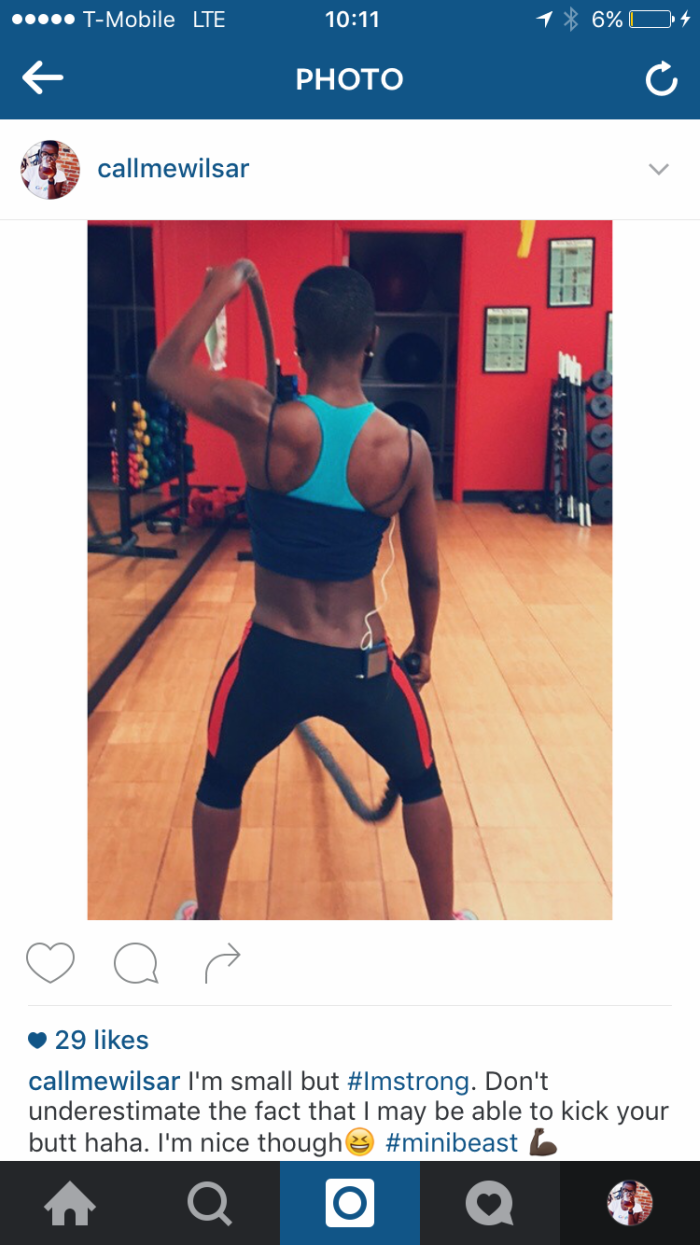
You look great (!) and you've stated eating healthy helps you remain in good shape even when you don't workout as often. Did minimalism influence your decision to improve your diet and become pescatarian? Can you share some simple meals you enjoy?
Minimalism played a small role in the way I eat (including becoming a pescatarian), but I’m weird because I’ve always eaten healthy, even in college haha. Because my mom worked, she used to cook once a week, and we’ll eat that meal (mostly Sierra Leonean food) all week. Back then, I didn’t know she was simply meal prepping so I grew up with that habit.
I cook my own meals (Lunch and Dinner, and I try to keep it simple) on Sundays. I rarely eat out (I brunch at least once/month). I’ve been a Pescatarian for less than a year, and I did it because I was just sick of eating meat, and wanted to see if I could do it. I decided to give it a try, and now I love it. I still miss steak, though. God, I love a good medium rare steak haha.
My go to meal is West African PB Stew with Rice, and all you need is:
Peanut Butter (creamy), tomato paste, your choice of protein, salt, pepper, and Adobo (my go to seasoning). Boil the ingredient together, and you’re done! I promise you, it’s delicious and a lot of my American friends love it lol. I should do a blog post about it so that people can try it at home haha.
You have the quote, "Know your passion, but be open to opportunities." pinned to the top of your twitter feed. How does your passion for fitness, politics, and tech intersect? What advice can you share about being open to opportunities and how to spot them.
I love that quote because it speaks to my life. I care about health and fitness, especially the way in which it affects the black community. My day job is politics and policy. I work on agricultural, environmental, and nutritional issues; in addition, I am a Digital Media Manager at work (which is where some of the tech comes in). Tech intrigues me, and I’m constantly awed by its influence in the health and fitness field. All three intersect because in order to reduce the rate of obesity in America, we should look at the policy we currently have.

You exude so much #blackgirlmagic, what is your secret to celebrating your authentic and essential self?
Honestly, I don’t take myself too seriously, I laugh a lot, and I workout (mentally and physically). I can’t say it enough, but exercise is my secret sauce. It makes me confident. It makes me feel sexy, and it allows me to approach things differently.
Wilsar also curates a dope IG account with all the #blackgirlmagic you can stand @blackgirlfriday.
How do you define being a black minimalist?
A black minimalist is someone who seeks to live a value added life. A black minimalist is someone who wants to be reintroduced to her/himself, and isn’t afraid to live outside of the norm.

Is there anything you'd like to add + where can we learn more about you?
I’m always brainstorming new projects. My brain refuses to give me a break haha.
I created Melanin Habits because I'm curious about productiveness and how certain habits can affect the way we work. The site's purpose is to showcase how some of the most successful black Influencers start their day.
It’s proven that having a dedicated morning routine affects the way we address our day so my goal is if we can read/see how some successful people start and/end their day, it may spark something in us; it may motivate someone else to reevaluate their mornings. It's a passion project of mine, and I’m afraid and excited to do it!
Twitter + Instagram: @MelaninHabits
Website: MelaninHabits.info
You can also find me on Twitter, Instagram, and Snapchat @CallMeWilsar. I’m very active on both! You can ask me almost anything and always looking to collaborate and brainstorm with like-minded people.
Learn more about Black Minimalists.
Black Minimalists: Cicely Renee

Black Minimalists: Cicely Renee
Cicely was featured in Black Minimalists on the Web Part Two.
When and why did you start your minimalist journey? What are your goals in living simply?
I started my minimalist journey Summer 2015. I realized I was stressed and it wasn’t due to work. I noticed I would get less productive with too many things and people in my space. I realized it wasn’t just stuff but was thoughts, people and busyness that needed to be minimized in my life. My goal is to have quality over quantity in every aspect of my life so that peace remains constant despite the chaos I cannot control.
You wrote a great post on 20 things to let go of before the new year. What are some things you left behind in 2015?
A few that stood out to me were, leaving behind my comfort zone, Facebook life comparisons, and last year. I left my comfort zone as I recently relocated to Dallas to really begin living again. I missed challenges and adventures and this was a great way to do so. I had gotten so comfortable and it made me so uncomfortable.
Facebook comparisons is a big one. After my divorce, I looked at people who got married around the same time celebrating their anniversaries, new babies, and purchasing their new homes and it hurt. It was taking too much space in my mind and was driving me crazy. Although it still is a struggle, I am making a conscientious decision on removing the thoughts and feelings.
In regards to last year, it was a rough one with my divorce and all. Life had changed drastically and I was just going with the flow. I couldn’t do that anymore and needed to be more intentional with my life and so in order for me to move on, I had to leave last year in its lane.
You mentioned you relocated across the country to Dallas. How did the move impact your minimalist journey? How did you prepare for the move? What minimalist tips do you have for others looking to relocate?
The move made me realize that I had too much stuff that brought me no joy. The move literally made me get rid of so many things. I was going to be staying with my aunt so I had to keep everything to a minimum and did not want to pay for storage. The move is allowing me to really start over and this allows me to be more thoughtful when I move into my new place.
When thinking about preparation, it was a huge mental thing because I was like what do I get rid of? My books were the hardest things; I love books.
My advice to minimalists looking to relocate is plan far in advance. Maybe you can sell the things so when moving, the costs won’t be so high. Also, think about it this way, this is the perfect opportunity to start from scratch and only have things that bring you joy.
You have some posts on "Masterpiece of Minimalism". PLEASE EXPLAIN THE PHRASE and what minimalism means to you.
I first heard the phrase in a negative context on Love Jones, when Lorenz’s character was asked about his book he was writing and he responded, “Masterpiece of Minimalism” and it stuck in my head. But when thinking about it in a freeing way, it brings a sense of mastering the art of minimalism in our lives. It is something we are aiming for.
You have talked about going through a divorce and often speak about it on your blog, how did that experience impact your journey? What advice do have for others on letting go, living single, and being happy?
I never thought about minimalism when I was married. I was focused on acquiring the perfect marriage, children, marriage activities and more. I wanted more out of my marriage and when that just brought more headache, I realized that less is really more.
My happiness was not attached to him, the things, the ideas of what marriage is “supposed” to look like. There were other things that were added in my life that brought so much stress and I was feeling so weighed down.
Although there was a lot of good in my life, there was so much bad that was weighing heavy and I had to reflect on what those things were and a plan to let those things go. My peace and joy means a lot to me and when I realized I was losing more peace and joy and gaining more headaches, it helped me come to terms with my divorce.
My advice would be not to focus on the bad or the good in your marriage, but on what you need in your life to bring you peace and joy. The divorce is an event that happened in your life, but your peace is something that is connected to you mentally, spiritually and emotionally.
Once you find your peace you will quickly notice when your peace is interrupted by things and people that enter your life and when you know it, it is easier for you to keep things at bay so that you can keep your peace. It is a freeing thing really. At this point living minimally comes more naturally.
In addition to blogging, you are a Social Media Marketing Strategist and you recently began work as a College and Career Coach (congrats!). Many of us are entrepreneurs and side hustlers in addition to our day jobs. What tips can you give on balancing and managing your passions, obligations, and personal life?
My biggest thing is organization. Oh my gosh, get a calendar and follow it… get your to-do list and do it… this was a hard reality I had to learn and messed up some things because I double booked.
My key tip is if you are working 40 hours for someone else, you need to work at least half of that for yourself. If you are passionate about what you do and want to become a full time entrepreneur, do not slack on your personal and business goals.
Also, find a job that will allow you the time you need to work on your endeavors. I was very excited about my new job because of the hours… I realized that I work best in the night time and day, NOT EARLY MORNING. So my new hours are 2-10 pm M-Th and 9-6 F.
I know that I can stay up late to work on blogging and getting things together. Between 10-1 I can work on my other business ventures. When I worked M-F, 9-6, I would be so exhausted and just sleep the rest of the evening or watch tv. With this new schedule I get to start with me first and that makes me happy. So knowing how you work and finding the right fit to allow you to work on you is key.
Additionally, what is one quick tip you can give minimalist entrepreneurs on simplifying our social media presence/marketing without reducing its impact and usefulness to our communities?
Social media marketing for business is King. Finding apps that help minimize the time spent pushing your content is key. Learning how to interconnect your platforms will be awesome when you can spend less time pushing and more time doing other things. I also do not think you need to be on EVERY app; no more than 5 will help keep your sanity. I personally use 3 for business and 2-3 for personal use.
What is your take on black minimalism?
When I think about black minimalism, I think first on the opposite end of the spectrum where being materialistic having more than enough comes into play. I just feel like when black people acquire things, they feel more powerful. I feel the release of things and ideas is so much more powerful. Letting go of the need to possess people, things, and ideas in fact is so much more freeing. I think black minimalism is a way to really cut the chains of bondage which will allow us to have a deeper connection to what is real and brings life to dead places.
where can we learn more about you?
You can learn about me at:
Site: www.bougieblackblogger.com
Facebook: www.facebook.com/love2loveyawords
Instagram: @bougieblackblogger
Twitter: @cicelyrenee
Email: bougieblackblogger@gmail.com
Learn more about other Black Minimalists.
What is a Black Minimalist?
Why black minimalist?
When I first had the idea of focusing on black minimalists, I had doubts. Did I need to place black in front of minimalist? Was I needlessly separating myself from the larger minimalist movement? I was also nervous about how my non-black readers would receive this new direction.
I was curious about whether our experience of minimalism was different from the dominant perspective. At the very least, I needed to tell my story. I felt there might be others needing to tell their stories, and still more, needing to hear stories that resonated with their experience.
I started searching for black people who identified as minimalists or who were living simply in some way; however they defined it.
When I talked with other black minimalists, I realized this could be something big. The response to my first post, Black Minimalists on the Web, was overwhelmingly positive and it affirmed our need to connect with one another.
What is a black minimalist?
A black person who adopts a simpler lifestyle as a means of liberation from anything that no longer serves her best self. The adoption of minimalism could be a response to overwhelming physical clutter, emotional baggage, financial debt, health concerns, or oppression. Any deep-seated desire to change one’s life can prompt a minimalist lifestyle. It also springs from a desire to liberate and positively impact black communities.
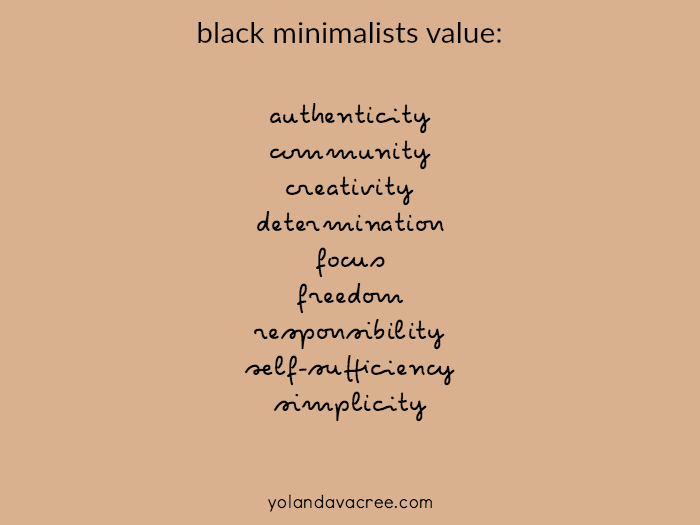
Why do we need a black minimalist movement?
I was perusing the web recently, doing my periodic search for black minimalist stuff to see if anything new turned up, and I stumbled upon this comment on a blog post from Joshua Becker’s site, Becoming Minimalist.
Jon says
March 31, 2012 at 3:45 am
Let me put forward a different perspective and one I’m sure may rub some the wrong way. I agree owning stuff is a burden on many levels but what if you are not white as many of you appear to be. Is minimalism and the discarding of all outward signs of status and identity a luxury only those in society who aren’t judged by virtue of their race necessarily can afford? If you were African American could you live a minimalist life, a life of simplicity and still be respected and treated well? Could it be that society would see you as inferior pandering to stereotypes if you don’t have wealth and material sign posts to validate your standing? For many minorities, having an outward display of abundance is the only way to gain respect and a foothold in a very unequal society. Therefore, is minimalism, much like golf, a white man’s philosophy?
Jon’s questions are important and some I’ve asked myself on this journey. His comment and some of the responses made me cringe a little though. For one, he is asking this question on a forum created by a white man and used by mainly white people. I don’t fault him for this because where else would he have asked this question. So much has happened in four years and there weren’t as many minimalist forums, let alone any platforms catering to black minimalists at this time.
Some of the responses, in my opinion, were dismissive of his concern or missed the point because if you’re not living the black experience in this country, how do you even know where he’s coming from? Fortunately, a few commenters did offer understanding and empathy for what Jon was trying to express. He never responded to the replies, but I hope he saw those last few comments affirming his experience.
Read the whole comment thread.
This movement is needed because we need a space where Jon and any other black person can feel comfortable asking these questions and not worry about rubbing someone the wrong way. I want for black people who want to live simply to know there is a community of people who understand where they are coming from and can offer insight. For these reasons, Black Minimalists will be expanding into an entity of its own in the near future.
Furthermore, the historical, social, political, economic, cultural, and spiritual implications of life in America, in the African Diaspora and on the African continent, also makes this movement necessary. Our liberation as individuals and communities is at stake. This is a call to create, build, and uplift our people in a way that disengages us from the norms of oppression. It reaffirms and celebrates the fact that we are enough and that we already have everything we need to free ourselves.
Questions from a black minimalist
I would like to briefly answer Jon's questions and invite you to share your thoughts in the comments.
Is minimalism and the discarding of all outward signs of status and identity a luxury only those in society who aren’t judged by virtue of their race necessarily can afford?
No and yes. It’s complicated. Any person, regardless of background, can do anything she wants in theory, including living simply. You can’t deny though, that we (black people and other minorities) are under a microscope. I’m at a point in my personal life where I care less and I think other black people are starting to care less too and the carefree black girl/boy movement beautifully shows that.
I think MamaJama’s comment hits on what Jon was getting at:
MamaJama says
July 28, 2014 at 8:48 am
In many cases, it can be shown, without a doubt that appearances can make or break (literally) a minority man. You’re debating a philosophy, a lifestyle, we’re talking about the freedom to live (in any form that doesn’t lead to one’s death based on one’s skin color). Don’t take your freedom (that eludes others) for granted.
If you were African American could you live a minimalist life, a life of simplicity and still be respected and treated well?
Yes, we do it everyday. I personally haven’t encountered any negativity regarding my lifestyle, but you can’t necessarily identify a minimalist just by looking. I don’t wear a sign that says “minimalist”. You’d have to take the time to get to know a person before learning that information unless they offer it upfront. So most of the time, we are not judged by our minimalist identity, but by other external factors.
Could it be that society would see you as inferior, pandering to stereotypes if you don’t have wealth and material sign posts to validate your standing?
Yes. Forget about minimalism for a moment and focus on history. American society has shown us repeatedly how it feels about black people and all other groups who do not fit in with the majority. We as a society place value on the attainment of certain material possessions and status positions. This is real regardless of your lifestyle.
People will judge you regardless of what you do, so why not live a life that is authentic and meaningful to you?
Is minimalism, much like golf, a white man’s philosophy?
No. Minimalism is a universal philosophy that has existed since humans came to be. Many people, including certain nomadic and religious societies, still practice living simplistically . White men and women may have popularized minimalism as a lifestyle trend in recent years, but minimalism is for everyone.
For those asking these questions, this is why I highlight black minimalists through interviews and roundups, this is why I talk about minimalism and black liberation, and this is why we have started having discussions via twitter. This is why I put black in front of minimalist.
Where can you learn more about black minimalists?
You can now find us on our website: blackminimalists.net.
Interviews
roundups
Black Minimalists on the Web Part One
Black Minimalists on the Web Part Two
Black Liberation + MINIMALISM
Minimalism for Black Liberation: Intro
6 Minimalists Principles for Black Liberation
Black Minimalist Icon: bell hooks
Discussions
Culture
Carefree Black Girl As Minimalist
Join the conversation on Twitter + Youtube.
ARE YOU A BLACK MINIMALIST CONTENT CREATOR? contact us at blkminimalists@gmail.com to BE FEATURED.
#BLKMINCHAT: March Recap
#BLKMINCHAT: March Recap- Minimalist Beauty

We held our second Black Minimalists twitter chat on minimalist beauty on March 3rd. Barbara from Jacq's Organics was our special guest. There were lots of great information, tips and hacks shared on simplifying your beauty routine. Check out the conversation below.

Question 1: Tell us about your beauty routine.
@blkminimalists A1: I'm Nyasha. I'm an academic/writer. I have a minimal beauty routine but have too many products. #blkminchat
— Nyasha Junior (@NyashaJunior) March 4, 2016
A1: @blkminimalists Hello Maggi here and this is my routine #blkminchat https://t.co/o8mQUt7CdL
— CluelessCurl (@CluelessCurl) March 4, 2016
Great routine. One way to maximize minimalist beauty is doing d.I.y. treatments at home #blkminchat https://t.co/0OXVh46DY3
— JACQS ORGANICS (@JacqsOrganics) March 4, 2016
Hi, my name is Aissatou & I blog at https://t.co/Z80bG2sPvQ. Moisturizing is key to my beauty routine. #blkminichat https://t.co/3oBgGibPES
— Aissatou (@cltrdmisprint) March 4, 2016
Yolanda here. Hi, everyone. Sorry I'm late. A1: My routine is super simple. Black soap, olive oil and bentonite clay mask. #blkminchat
— Yolanda V Acree (@YolandaVAcree) March 4, 2016

Question 2: What benefits have you experienced with simplifying your routine.
@blkminimalists @JacqsOrganics Time, money, and the creativity. #blkminchat
— CluelessCurl (@CluelessCurl) March 4, 2016
@blkminimalists @JacqsOrganics I've gained clarity. I needed clarity.
— Wilsar™ (@CallMeWilsar) March 4, 2016

Question 3: What resources have you used to help simplify your routine?
Sleep & water! I could do away w/ concealer if I slept for more than 6 hours a night & drank water #blkminchat https://t.co/ZVcwIVHrAR
— Aissatou (@cltrdmisprint) March 4, 2016
Q3: @blkminimalists @JacqsOrganics The Internet and also the people we follow on social media #blkminchat
— CluelessCurl (@CluelessCurl) March 4, 2016

Question 4: Share one of your favorite DIY treatments, hacks, tips or minimalist product.
A4 To close my pores before adding makeup. I massage my face w/ an ice cube. @blkminimalists @JacqsOrganics #blkminchat
— Cleverly Changing (@Cleverlychangin) March 4, 2016
@blkminimalists @JacqsOrganics #blkminchat Don't throw away bottles. I transfer new into old b/c of leak proof top pic.twitter.com/nHwoJtsZGO
— CluelessCurl (@CluelessCurl) March 4, 2016
Black soap worked wonders for my acne and I only use it every other day. I also use witch hazel to tone. #blkminchat https://t.co/UGflRUBhZX
— Yolanda V Acree (@YolandaVAcree) March 4, 2016
You can also leave your moisturizer or serum in fridge which helps with this and closing pores. #blkminchat https://t.co/WYUMoSakGK
— JACQS ORGANICS (@JacqsOrganics) March 4, 2016
Q4: You can also use toilet seat covers as blotting paper. @JacqsOrganics JacqsOrganics @blkminimalists #blkminchat
— CluelessCurl (@CluelessCurl) March 4, 2016
Thank you to everyone who joined us. Our monthly chats will continue and the next one will be April 7th. The topic will be minimalist style with wardrobe stylist Lemar Moda.

Black Minimalist Icon: bell hooks

Black Minimalist Icon: bell hooks
When I first started thinking about minimalism and its connection to black liberation, I searched for thought leaders who could articulate what I was feeling. I came upon bell hooks’s chapter in Black Genius: African American Solutions to African American Problems, titled “Simple Living: An Antidote to Hedonistic Materialism” and I knew I had struck black gold.
To celebrate black history month and women’s history month, I would like to acknowledge bell hooks. A scholar, activist, and author who examines the intersections of race, gender, class, and education in a "white supremacist, capitalist patriarchy" aka the U.S.
This post is merely to introduce hooks as a black minimalist scholar and icon. Yes, I’m claiming her for our cause!
Below, I have pulled out a few quotes from her work and offered my thoughts.
From the chapter:
“I began to look at other African Americans, cross class, and to think about how much pain I saw in their daily lives, how much stress and mental delusion are caused by constant feelings of lack. We who are privileged spread the message to the less privileged that their lives have no meaning if they do not have the freedom to fulfill hedonistic desires for material goods. The black women and men I talk to who live in housing projects keep saying they want things endlessly because they feel that things will make them somebody and give them the value they feel they do not have.” (138-139)
What hooks observed and what is still occurring today in many black communities, echoes the national trend of excessive materialism; however, the history of black economic exploitation makes this examination particularly crushing.
“Were the masses of black people to embrace the philosophy of living simply as a way of countering the genocidal abuse in our lives fostered by imperialism, white supremacy, and capitalism, we would also be uniting our struggle with that of most of the people on the planet who are daily grievously victimized by the material excess of this society.” (143)
The struggle for black liberation is not occurring in a vacuum and throughout the history of black liberation movements, we have linked our struggles to the global human struggle for freedom. Having said that, we can not fail to acknowledge the impact and contribution our materialism has played in the suffering of the global community.
After finding that piece, I also read a couple of her other works, Rock My Soul: Black People and Self Esteem and Ain't I A Woman: Black Women and Feminism where she continues to discuss the need for us to divest from the myth of the American Dream and embrace a simple lifestyle for our spiritual and emotional well-being.
From Rock My Soul:
“When the seventies ended, it was popularly accepted that material goods and acquisition of power within the existing structure of our society was more attainable than freedom… Rather than worry our minds and hearts about social justice, anti-racist struggle, women’s liberation, the plight of the poor, or the failure of democratic principles, black people were urged to see consumption as a way to define success and well-being.” (10-11)
The first sentence of that quote is particularly conflicting for me. Are we wrong for wanting to get our slice of the American pie and use our talents to achieve? On the other hand, what have we gained by participating in the system?
Black wealth is still 13 times less than white wealth even though we have high rates of college completion and entrepreneurship, with black women leading those categories.
“Confronting chronic emotional pain in black life is the terrain of political resistance we must now explore, the new revolutionary frontier- mental health, emotional well-being.” (159)
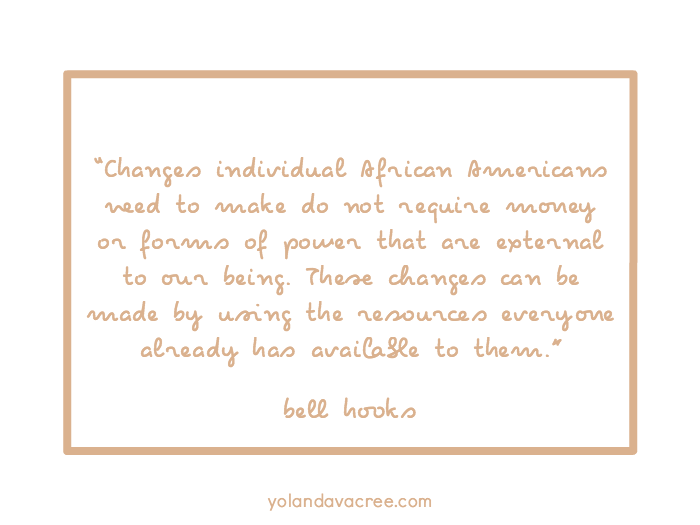
“Changes individual African Americans need to make do not require money or forms of power that are external to our being. These changes can be made by using the resources everyone already has available to them.” (206)
I have been saying this and I’ll keep saying it. This is a spiritual journey. I’m not just referring to minimalism, but our liberation too. The passion that we have for justice springs from so much pain. To be truly radical, we have to confront the pain of injustice and heal. It starts internally with each individual. Minimalism is a tool that can help us heal ourselves, our families, and our communities.
I encourage you to dig more into bell hooks’s work. She also has some great live discussions on Youtube. There is a lot to unpack and she provides a great foundation for understanding the political, spiritual, and socio-economic factors of our struggle for freedom and how simple living can liberate us.
Who has influenced your thinking on black minimalism? What other thought leaders should we check out?