What is a Black Minimalist?
Why black minimalist?
When I first had the idea of focusing on black minimalists, I had doubts. Did I need to place black in front of minimalist? Was I needlessly separating myself from the larger minimalist movement? I was also nervous about how my non-black readers would receive this new direction.
I was curious about whether our experience of minimalism was different from the dominant perspective. At the very least, I needed to tell my story. I felt there might be others needing to tell their stories, and still more, needing to hear stories that resonated with their experience.
I started searching for black people who identified as minimalists or who were living simply in some way; however they defined it.
When I talked with other black minimalists, I realized this could be something big. The response to my first post, Black Minimalists on the Web, was overwhelmingly positive and it affirmed our need to connect with one another.
What is a black minimalist?
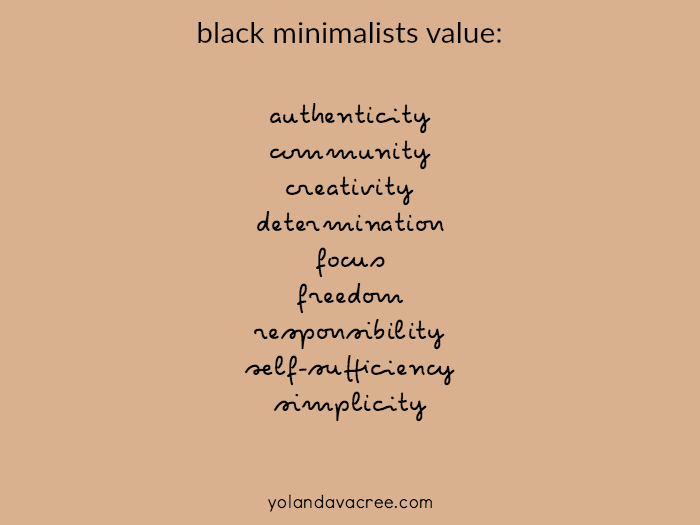
A black person who adopts a simpler lifestyle as a means of liberation from anything that no longer serves her best self. The adoption of minimalism could be a response to overwhelming physical clutter, emotional baggage, financial debt, health concerns, or oppression. Any deep-seated desire to change one’s life can prompt a minimalist lifestyle. It also springs from a desire to liberate and positively impact black communities.
Why do we need a black minimalist movement?
I was perusing the web recently, doing my periodic search for black minimalist stuff to see if anything new turned up, and I stumbled upon this comment on a blog post from Joshua Becker’s site, Becoming Minimalist.
Jon says
March 31, 2012 at 3:45 am
Let me put forward a different perspective and one I’m sure may rub some the wrong way. I agree owning stuff is a burden on many levels but what if you are not white as many of you appear to be. Is minimalism and the discarding of all outward signs of status and identity a luxury only those in society who aren’t judged by virtue of their race necessarily can afford? If you were African American could you live a minimalist life, a life of simplicity and still be respected and treated well? Could it be that society would see you as inferior pandering to stereotypes if you don’t have wealth and material sign posts to validate your standing? For many minorities, having an outward display of abundance is the only way to gain respect and a foothold in a very unequal society. Therefore, is minimalism, much like golf, a white man’s philosophy?
Jon’s questions are important and some I’ve asked myself on this journey. His comment and some of the responses made me cringe a little though. For one, he is asking this question on a forum created by a white man and used by mainly white people. I don’t fault him for this because where else would he have asked this question. So much has happened in four years and there weren’t as many minimalist forums, let alone any platforms catering to black minimalists at this time.
Some of the responses, in my opinion, were dismissive of his concern or missed the point because if you’re not living the black experience in this country, how do you even know where he’s coming from? Fortunately, a few commenters did offer understanding and empathy for what Jon was trying to express. He never responded to the replies, but I hope he saw those last few comments affirming his experience.
Read the whole comment thread.
This movement is needed because we need a space where Jon and any other black person can feel comfortable asking these questions and not worry about rubbing someone the wrong way. I want for black people who want to live simply to know there is a community of people who understand where they are coming from and can offer insight. For these reasons, Black Minimalists will be expanding into an entity of its own in the near future.
Furthermore, the historical, social, political, economic, cultural, and spiritual implications of life in America, in the African Diaspora and on the African continent, also makes this movement necessary. Our liberation as individuals and communities is at stake. This is a call to create, build, and uplift our people in a way that disengages us from the norms of oppression. It reaffirms and celebrates the fact that we are enough and that we already have everything we need to free ourselves.
Questions from a black minimalist
I would like to briefly answer Jon's questions and invite you to share your thoughts in the comments.
Is minimalism and the discarding of all outward signs of status and identity a luxury only those in society who aren’t judged by virtue of their race necessarily can afford?
No and yes. It’s complicated. Any person, regardless of background, can do anything she wants in theory, including living simply. You can’t deny though, that we (black people and other minorities) are under a microscope. I’m at a point in my personal life where I care less and I think other black people are starting to care less too and the carefree black girl/boy movement beautifully shows that.
I think MamaJama’s comment hits on what Jon was getting at:
MamaJama says
July 28, 2014 at 8:48 am
In many cases, it can be shown, without a doubt that appearances can make or break (literally) a minority man. You’re debating a philosophy, a lifestyle, we’re talking about the freedom to live (in any form that doesn’t lead to one’s death based on one’s skin color). Don’t take your freedom (that eludes others) for granted.
If you were African American could you live a minimalist life, a life of simplicity and still be respected and treated well?
Yes, we do it everyday. I personally haven’t encountered any negativity regarding my lifestyle, but you can’t necessarily identify a minimalist just by looking. I don’t wear a sign that says “minimalist”. You’d have to take the time to get to know a person before learning that information unless they offer it upfront. So most of the time, we are not judged by our minimalist identity, but by other external factors.
Could it be that society would see you as inferior, pandering to stereotypes if you don’t have wealth and material sign posts to validate your standing?
Yes. Forget about minimalism for a moment and focus on history. American society has shown us repeatedly how it feels about black people and all other groups who do not fit in with the majority. We as a society place value on the attainment of certain material possessions and status positions. This is real regardless of your lifestyle.
People will judge you regardless of what you do, so why not live a life that is authentic and meaningful to you?
Is minimalism, much like golf, a white man’s philosophy?
No. Minimalism is a universal philosophy that has existed since humans came to be. Many people, including certain nomadic and religious societies, still practice living simplistically . White men and women may have popularized minimalism as a lifestyle trend in recent years, but minimalism is for everyone.
For those asking these questions, this is why I highlight black minimalists through interviews and roundups, this is why I talk about minimalism and black liberation, and this is why we have started having discussions via twitter. This is why I put black in front of minimalist.
Where can you learn more about black minimalists?
You can now find us on our website: blackminimalists.net.
Interviews
roundups
Black Minimalists on the Web Part One
Black Minimalists on the Web Part Two
Black Liberation + MINIMALISM
Minimalism for Black Liberation: Intro
6 Minimalists Principles for Black Liberation
Black Minimalist Icon: bell hooks
Discussions
Culture
Carefree Black Girl As Minimalist
Join the conversation on Twitter + Youtube.
ARE YOU A BLACK MINIMALIST CONTENT CREATOR? contact us at blkminimalists@gmail.com to BE FEATURED.
Black Minimalist Icon: bell hooks

Black Minimalist Icon: bell hooks
When I first started thinking about minimalism and its connection to black liberation, I searched for thought leaders who could articulate what I was feeling. I came upon bell hooks’s chapter in Black Genius: African American Solutions to African American Problems, titled “Simple Living: An Antidote to Hedonistic Materialism” and I knew I had struck black gold.
To celebrate black history month and women’s history month, I would like to acknowledge bell hooks. A scholar, activist, and author who examines the intersections of race, gender, class, and education in a "white supremacist, capitalist patriarchy" aka the U.S.
This post is merely to introduce hooks as a black minimalist scholar and icon. Yes, I’m claiming her for our cause!
Below, I have pulled out a few quotes from her work and offered my thoughts.
From the chapter:
“I began to look at other African Americans, cross class, and to think about how much pain I saw in their daily lives, how much stress and mental delusion are caused by constant feelings of lack. We who are privileged spread the message to the less privileged that their lives have no meaning if they do not have the freedom to fulfill hedonistic desires for material goods. The black women and men I talk to who live in housing projects keep saying they want things endlessly because they feel that things will make them somebody and give them the value they feel they do not have.” (138-139)
What hooks observed and what is still occurring today in many black communities, echoes the national trend of excessive materialism; however, the history of black economic exploitation makes this examination particularly crushing.
“Were the masses of black people to embrace the philosophy of living simply as a way of countering the genocidal abuse in our lives fostered by imperialism, white supremacy, and capitalism, we would also be uniting our struggle with that of most of the people on the planet who are daily grievously victimized by the material excess of this society.” (143)
The struggle for black liberation is not occurring in a vacuum and throughout the history of black liberation movements, we have linked our struggles to the global human struggle for freedom. Having said that, we can not fail to acknowledge the impact and contribution our materialism has played in the suffering of the global community.
After finding that piece, I also read a couple of her other works, Rock My Soul: Black People and Self Esteem and Ain't I A Woman: Black Women and Feminism where she continues to discuss the need for us to divest from the myth of the American Dream and embrace a simple lifestyle for our spiritual and emotional well-being.
From Rock My Soul:
“When the seventies ended, it was popularly accepted that material goods and acquisition of power within the existing structure of our society was more attainable than freedom… Rather than worry our minds and hearts about social justice, anti-racist struggle, women’s liberation, the plight of the poor, or the failure of democratic principles, black people were urged to see consumption as a way to define success and well-being.” (10-11)
The first sentence of that quote is particularly conflicting for me. Are we wrong for wanting to get our slice of the American pie and use our talents to achieve? On the other hand, what have we gained by participating in the system?
Black wealth is still 13 times less than white wealth even though we have high rates of college completion and entrepreneurship, with black women leading those categories.
“Confronting chronic emotional pain in black life is the terrain of political resistance we must now explore, the new revolutionary frontier- mental health, emotional well-being.” (159)
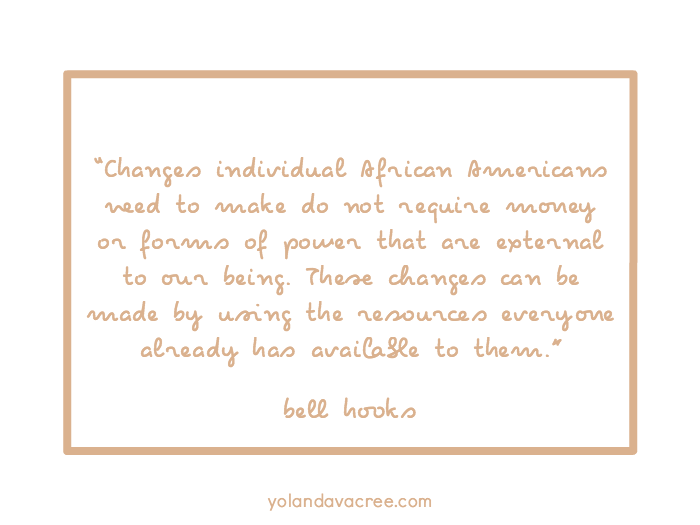
“Changes individual African Americans need to make do not require money or forms of power that are external to our being. These changes can be made by using the resources everyone already has available to them.” (206)
I have been saying this and I’ll keep saying it. This is a spiritual journey. I’m not just referring to minimalism, but our liberation too. The passion that we have for justice springs from so much pain. To be truly radical, we have to confront the pain of injustice and heal. It starts internally with each individual. Minimalism is a tool that can help us heal ourselves, our families, and our communities.
I encourage you to dig more into bell hooks’s work. She also has some great live discussions on Youtube. There is a lot to unpack and she provides a great foundation for understanding the political, spiritual, and socio-economic factors of our struggle for freedom and how simple living can liberate us.
Who has influenced your thinking on black minimalism? What other thought leaders should we check out?
Black Minimalists: Nikki Terry
Black Minimalists: Nikki Terry
When and why did you start your minimalist journey?
I was born a minimalist. I also copied my Dad. His style: dress pants, white cotton V-neck t- shirt and thong toe sandals. Aside from a suit for church, this was his every day swag. I remember thinking how simple and sexy it all was. No, actually I thought it was all beautiful.
Being a minimalist is how I see things. It's a need to have a clutter-free mind. I’m a minimalist so I can understand the important things in my life. I come from a complicated childhood and often, things felt confusing and problematic. Moving out on my own, I had a difficult time navigating what my thoughts were, how to value my own time, or how to enjoy things without wavering back and forth between ‘not sure’ or ‘maybe so’. I suppose the minimalist GODS were waiting for me because moving into my first apartment, minimalism found me in the most organic way. I immediately and instinctively felt a need to have one of everything. Aside from my bed, I had one dinner tray, a small stereo, one chair, one set of flatware, and a few plates. I did have lots of bath towels ranging in hues of gray. My friends found it weird, but I thought my choices made my place ready for Elle Decor. Being a minimalist brought a lot of calm to a world that felt overwhelming.
What lessons have you learned since going minimalist?
I have learned people think in order to be a minimalist, you have to have money or be of a certain class. NOT TRUE.
I am a minimalist to the core. I don’t have a lot of money and I definitely did not come from a middle class nor upper middle class family. I believe in monochromatic interior space. I have a particular eye for clothing. I keep the interior of my car clean and free of almost everything outside of the panel board. I have a certain aesthetic that I enjoy when I dress. None of this makes me someone with money. Minimalism for me is all about emotional and mental space. These things make me happy, and calm. It creates a space for me to understand the value of who I am. Being a minimalist has nothing to do with class but has everything to do with those moments in life where there are no blinders, no noise, nor clutter.
What are your goals in living simply?
I'm an artist. My job is to recreate how I see the world. There are aspects of life that are beautiful and quiet, pretty and empty, or dark and loud. Being a minimalist helps me to see and understand these human qualities. I approach the canvas slowly and paint what I see.

Has minimalism impacted other areas of your life?
I thought to mention how minimalism has impacted my life as an artist, but then I decided to talk about the strongest impact minimalism has made on my life. How I choose my friends. I’m not saying that my friends have to be minimalist but I try to have relationships that are deliberate and without competition.
What if any surprises or challenges have you encountered?
The biggest challenge encountered as a minimalist was finding a partner who also believed in minimalism or at least understood it. Some women I have dated referred to me as ‘cheap’. Even friends called me ‘cheap’. I never saw it that way. I think of myself as fiscally savvy (smile). But seriously, I never saw myself as cheap but just a strong pull to stay true to what I enjoy. Now, my Partner, she is a minimalist too. It’s wonderful! She is just as committed to a minimalist lifestyle as me. Decorating our place is easy and fun. We enjoy monochromatic palettes and gosh, it's great having a partner who is okay with not having a television.
What mindset changes have you experienced?
Accepting some people can’t understand minimalism. They don’t get it. I don’t fuss about it. I just do my thing.
What advice do you have for someone interested in simplifying her life?
My advice is simple, go for it. If it feels right, enjoy it. If you don’t want to buy a television, don’t. If you don’t want three sets of flatware, have only one. If you want all the hangers in your closet to be chrome, have them and let them face the same direction. Whatever or however you want to simplify your life, go for it and never second guess that desire.
Where can we learn more about you?
www.orangecustard.com and www.nikkiterry.com
Anything you would like to add?
Being a minimalist does not involve snobbery. It simply involves the joys of having as close to a clutter free life as possible.
Learn more about Black Minimalism.
Minimalism for Black Liberation
Minimalism for Black Liberation is a series that explores the ways in which minimalism can be adapted in the struggle for black liberation.
The injustices committed against black people over the past several years have brought a renewed focus to the struggle for black liberation. Even after progress has been made in education, politics, financial security, and other areas, it's still rare to go a day without hearing about some racist BS whether it be through the personal stories of friends and family or via the media at large.
I've struggled to find a way to make sense of it all, sometimes it feels surreal to me that in 2015, with all the advancements the human race has made, racism is still alive and kicking. That's the thing about racism though, it's insidious. It doesn't matter how good a person you are, how much you've accomplished, whether you're law abiding, or you're a human being whose life deserves respect regardless, you're judged and acted upon based on perceived notions and hatred because of the color of your skin.
History has shown oppression and racism are here to stay for the time being, so what do we do? How can we rise above it and keep pressing forward? How can I affect the struggle for black liberation in a way that feels authentic? My answer to those questions is minimalism. It's a lifestyle I've adapted that has significantly changed my life and how I view the world, and I believe it's a possible solution for advancing our freedom as individuals and communities.
Black liberation is an ideology that supports the mental, emotional, socio-economic, socio-political, spiritual, and physical liberation of black people.
Black liberation encourages the resilience, creativity, intelligence, and strength of black people to create opportunities and solutions for our progress.
It seeks to neutralize the effects of racism as demonstrated through colonialism and neocolonialism, slavery, terrorism and genocide, capitalism, classism, sexism, authoritarianism, disenfranchisement, and other forms of oppression. It is not our responsibility to eradicate racism, but we will continue to expose it in all its forms.
Black liberation will only be achieved by us, when we accept the responsibility of freeing ourselves.
Black liberation like peace or happiness, is not a destination to be arrived at, but a lifelong journey. The struggle will continue as long as we exist.
The main purpose of this project is to introduce minimalism as a possible option for the achievement of black liberation. Minimalism works because it is a lifestyle and mindset change. We can not keep doing the same things and expect radical change to occur.
Minimalism is also viable because it encourages self-sufficiency, efficient and responsible use of resources, healthy living, and anti- consumerism and materialism. Minimalism encourages a break from societal and systemic norms.It works for individuals, families, and can work for our communities.
Minimalism is not a new concept or practice, although it has become more popular and trendy in the past several years.It can be summed up as living simply, be and doing more with less. Many peoples, including blacks, have lived this way throughout time and only recently, in the past 200 years or so, has that changed. It’s a part of our collective consciousness and we need to revisit and adapt minimalism to our current situation.
This series is going to explore the ways in which blacks can use minimalism as a tool to support our freedom and will serve as an overview. We will briefly examine the following: principles of black liberation and minimalism and how they intersect and compliment one another, historical and current black liberation groups to see what lessons can be learned and incorporated, and the current state of black America including economic, educational, political, and social measures and how minimalism can affect change in these areas.
Freedom ain’t free. What are you willing to give up to be free?

Pros and Cons of Minimalism

With everything you encounter in life, there are benefits and drawbacks, and minimalism is no different. While I think simple living is great overall, it's important to consider some valid pros and cons of minimalism.
I'll state the obvious first.
The obvious pros are you have less clutter, you're more organized, you save time, you're better able to prioritize, you focus on experiences over stuff, and you save money because you're not buying a whole bunch of crap you don't need.
The obvious cons are you can't always get what you want and your options in some situations are limited.
Below I'm going to address the pros and cons of five issues within minimalism.
#1: Be willing to commit and forego.
Con: It's difficult to embrace a minimalist lifestyle.
On the surface, getting rid of stuff seems easy enough, but it actually requires a lot of willpower and willingness to go beyond our mental and sentimental attachments to things.
The process of decluttering can feel very stressful and overwhelming in the beginning. Memories and emotions surface as you go through your stuff. Evaluating relationships or changing career paths can be upsetting if you're not prepared.
Additionally, as you shed your old lifestyle, you may find yourself asking, "Who am I now? I will address this in more detail later.
Pro: Once you get through the initial discomfort of letting things go, the process becomes easier.
You're able to efficiently decide what is right for you. You can better identify the pros and cons of any situation. You're also better able to separate yourself from things that don't matter to you personally.
#2: There is no standard of minimalism. No rule book. It's an open and accepting lifestyle. You only need to figure out what works for you and eliminate the rest.
Con: Deciding what minimalism means for you can be confusing and overwhelming.
There are many people discussing minimalism and simple living. You can find them via blogs, YouTube, and books. We share our stories with you, but it is a very personal journey.
It can be difficult for you to break from your set way of living. You may not know anyone in real life who is modeling minimalist behavior. So it can be difficult to define it for yourself, if you don't encounter it in your everyday life.
Pro: You are in control and get to define minimalism for yourself.
No one can tell you what it means for you to be a minimalist.
We who discuss minimalism are merely providing guides and suggestions based on our own experiences.
If you accept the responsibility of becoming a minimalist, it can be very empowering. You are the expert on you and no one gets to tell you how to live your life.
#3: Shiny Object Syndrome
Con: You're not easily impressed and are cured of shiny object syndrome.
This may sound like a pro, but the reality is that many things begin to lose their luster and there is a danger in being underwhelmed.
We all consume a lot of information via the media and real life interactions. If you're a realist like me, then you already approach many things with neutrality or some skepticism.
Since becoming a minimalist, I'm even more hesitant to accept things on the surface and need to know more before embracing something.
I don't want to lose my ability to wowed and you should be concerned about this too. As kids, we're impressed by everything and possess an innocent curiosity, but with adulthood comes, "been there, done that".
This is a warning. Don't lose your sense of wonder. Allow yourself to be awed. You don't have to own something to enjoy it.
Pro: You can determine the value of things and dig deeper into them.
Not getting caught up in the bright lights, allows you determine more accurately if something has value for you and is worth your time, attention, and wonder.
You may also find other things to engage your attention like nature, travel, or a hobby you've always wanted to try, but never had the time before.
#4: Gratification
Con: You have to pass over a lot of things that you "like" along the way and even if you encounter something you "love", it may not be the right time to have it.
With minimalism you're committed to the things you need and love.
You constantly have to question your own motives and desires and guard against the mind's justifications for wanting things.
Pro: You develop discipline and patience which eventually helps you curb your desire for more.
We are constantly bombarded with messages to consume everywhere we go. It's not wrong to find yourself still wanting things even as you embrace minimalism. Overtime, shiny object syndrome wears off and you cease to want as much stuff.
Read some (not so) surprising facts about what we consume in America.
#5: People and you.
Con: A minimalist lifestyle can be lonely.
Earlier we discussed having to define minimalism for yourself and not knowing people who share your lifestyle. Your friends may want to hang out by going shopping and that might not appeal to you anymore.
You may not have someone to talk to in real life who understands your new lifestyle. People may question your motives because the majority of people in this country do not live minimally.
You may need to separate yourself from people you know and care about because they are engaging in things that don't align with your goals and values.
Additionally, you have to check your expectations of yourself and others. I talked about this in my video on deciding to be happy.
Other people don't have to understand your lifestyle and you shouldn't expect them to. The most you can ask is that they respect you and your wishes. You have to remember, they're not changing their lives, you're changing yours.
You learn to be okay with being more independent, to understand what it means to be alone or lonely at times, and you learn to say "no" more. It may feel uncomfortable for you personally, but you will grow from it.
It takes grit to stand in your truth and do what's best for you.
Pro: Ultimately, you will come to understand yourself better and deepen your spirituality. Minimalism can also improve and deepen your relationships.
When you're alone, there is nothing to distract you from the business of knowing you. Questions such as, "Who am I?", "Is this what I want for my life?", and "What is my purpose?" will arise.
These questions come up at some point in everyone's life journey, but with minimalism they will arise persistently. Life changes create opportunities for your enlightenment and allow you to strengthen your inner self.
You will be mindful about the time and experiences you have with others. You may also have the opportunity to share your minimalist experiences with your family and friends and may get to help them on their own journeys.
Tell me some of your pros and cons of minimalism.
P.S. Need a practical, no-nonsense guide to simplify your life? Get your copy of Mindful Simplicity today.
*This post contains an affiliate link. I am a participant in the Amazon Services LLC Associates Program, an affiliate advertising program designed to provide a means for us to earn fees by linking to Amazon.com and affiliated sites.