What is a Black Minimalist?
Why black minimalist?
When I first had the idea of focusing on black minimalists, I had doubts. Did I need to place black in front of minimalist? Was I needlessly separating myself from the larger minimalist movement? I was also nervous about how my non-black readers would receive this new direction.
I was curious about whether our experience of minimalism was different from the dominant perspective. At the very least, I needed to tell my story. I felt there might be others needing to tell their stories, and still more, needing to hear stories that resonated with their experience.
I started searching for black people who identified as minimalists or who were living simply in some way; however they defined it.
When I talked with other black minimalists, I realized this could be something big. The response to my first post, Black Minimalists on the Web, was overwhelmingly positive and it affirmed our need to connect with one another.
What is a black minimalist?
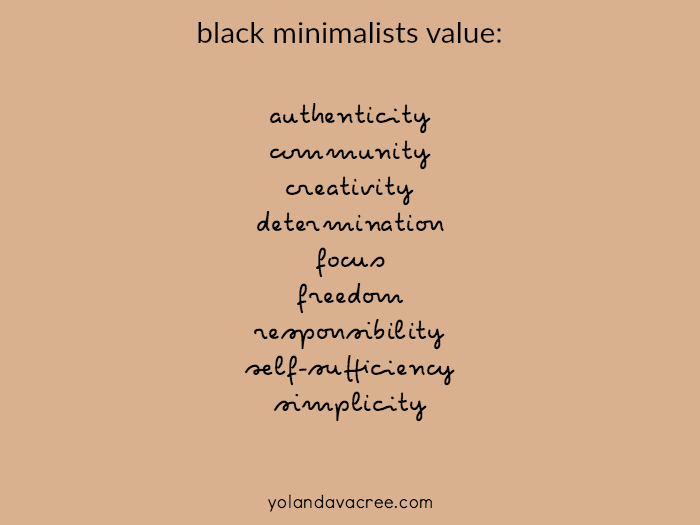
A black person who adopts a simpler lifestyle as a means of liberation from anything that no longer serves her best self. The adoption of minimalism could be a response to overwhelming physical clutter, emotional baggage, financial debt, health concerns, or oppression. Any deep-seated desire to change one’s life can prompt a minimalist lifestyle. It also springs from a desire to liberate and positively impact black communities.
Why do we need a black minimalist movement?
I was perusing the web recently, doing my periodic search for black minimalist stuff to see if anything new turned up, and I stumbled upon this comment on a blog post from Joshua Becker’s site, Becoming Minimalist.
Jon says
March 31, 2012 at 3:45 am
Let me put forward a different perspective and one I’m sure may rub some the wrong way. I agree owning stuff is a burden on many levels but what if you are not white as many of you appear to be. Is minimalism and the discarding of all outward signs of status and identity a luxury only those in society who aren’t judged by virtue of their race necessarily can afford? If you were African American could you live a minimalist life, a life of simplicity and still be respected and treated well? Could it be that society would see you as inferior pandering to stereotypes if you don’t have wealth and material sign posts to validate your standing? For many minorities, having an outward display of abundance is the only way to gain respect and a foothold in a very unequal society. Therefore, is minimalism, much like golf, a white man’s philosophy?
Jon’s questions are important and some I’ve asked myself on this journey. His comment and some of the responses made me cringe a little though. For one, he is asking this question on a forum created by a white man and used by mainly white people. I don’t fault him for this because where else would he have asked this question. So much has happened in four years and there weren’t as many minimalist forums, let alone any platforms catering to black minimalists at this time.
Some of the responses, in my opinion, were dismissive of his concern or missed the point because if you’re not living the black experience in this country, how do you even know where he’s coming from? Fortunately, a few commenters did offer understanding and empathy for what Jon was trying to express. He never responded to the replies, but I hope he saw those last few comments affirming his experience.
Read the whole comment thread.
This movement is needed because we need a space where Jon and any other black person can feel comfortable asking these questions and not worry about rubbing someone the wrong way. I want for black people who want to live simply to know there is a community of people who understand where they are coming from and can offer insight. For these reasons, Black Minimalists will be expanding into an entity of its own in the near future.
Furthermore, the historical, social, political, economic, cultural, and spiritual implications of life in America, in the African Diaspora and on the African continent, also makes this movement necessary. Our liberation as individuals and communities is at stake. This is a call to create, build, and uplift our people in a way that disengages us from the norms of oppression. It reaffirms and celebrates the fact that we are enough and that we already have everything we need to free ourselves.
Questions from a black minimalist
I would like to briefly answer Jon's questions and invite you to share your thoughts in the comments.
Is minimalism and the discarding of all outward signs of status and identity a luxury only those in society who aren’t judged by virtue of their race necessarily can afford?
No and yes. It’s complicated. Any person, regardless of background, can do anything she wants in theory, including living simply. You can’t deny though, that we (black people and other minorities) are under a microscope. I’m at a point in my personal life where I care less and I think other black people are starting to care less too and the carefree black girl/boy movement beautifully shows that.
I think MamaJama’s comment hits on what Jon was getting at:
MamaJama says
July 28, 2014 at 8:48 am
In many cases, it can be shown, without a doubt that appearances can make or break (literally) a minority man. You’re debating a philosophy, a lifestyle, we’re talking about the freedom to live (in any form that doesn’t lead to one’s death based on one’s skin color). Don’t take your freedom (that eludes others) for granted.
If you were African American could you live a minimalist life, a life of simplicity and still be respected and treated well?
Yes, we do it everyday. I personally haven’t encountered any negativity regarding my lifestyle, but you can’t necessarily identify a minimalist just by looking. I don’t wear a sign that says “minimalist”. You’d have to take the time to get to know a person before learning that information unless they offer it upfront. So most of the time, we are not judged by our minimalist identity, but by other external factors.
Could it be that society would see you as inferior, pandering to stereotypes if you don’t have wealth and material sign posts to validate your standing?
Yes. Forget about minimalism for a moment and focus on history. American society has shown us repeatedly how it feels about black people and all other groups who do not fit in with the majority. We as a society place value on the attainment of certain material possessions and status positions. This is real regardless of your lifestyle.
People will judge you regardless of what you do, so why not live a life that is authentic and meaningful to you?
Is minimalism, much like golf, a white man’s philosophy?
No. Minimalism is a universal philosophy that has existed since humans came to be. Many people, including certain nomadic and religious societies, still practice living simplistically . White men and women may have popularized minimalism as a lifestyle trend in recent years, but minimalism is for everyone.
For those asking these questions, this is why I highlight black minimalists through interviews and roundups, this is why I talk about minimalism and black liberation, and this is why we have started having discussions via twitter. This is why I put black in front of minimalist.
Where can you learn more about black minimalists?
You can now find us on our website: blackminimalists.net.
Interviews
roundups
Black Minimalists on the Web Part One
Black Minimalists on the Web Part Two
Black Liberation + MINIMALISM
Minimalism for Black Liberation: Intro
6 Minimalists Principles for Black Liberation
Black Minimalist Icon: bell hooks
Discussions
Culture
Carefree Black Girl As Minimalist
Join the conversation on Twitter + Youtube.
ARE YOU A BLACK MINIMALIST CONTENT CREATOR? contact us at blkminimalists@gmail.com to BE FEATURED.
Black Minimalist Icon: bell hooks

Black Minimalist Icon: bell hooks
When I first started thinking about minimalism and its connection to black liberation, I searched for thought leaders who could articulate what I was feeling. I came upon bell hooks’s chapter in Black Genius: African American Solutions to African American Problems, titled “Simple Living: An Antidote to Hedonistic Materialism” and I knew I had struck black gold.
To celebrate black history month and women’s history month, I would like to acknowledge bell hooks. A scholar, activist, and author who examines the intersections of race, gender, class, and education in a "white supremacist, capitalist patriarchy" aka the U.S.
This post is merely to introduce hooks as a black minimalist scholar and icon. Yes, I’m claiming her for our cause!
Below, I have pulled out a few quotes from her work and offered my thoughts.
From the chapter:
“I began to look at other African Americans, cross class, and to think about how much pain I saw in their daily lives, how much stress and mental delusion are caused by constant feelings of lack. We who are privileged spread the message to the less privileged that their lives have no meaning if they do not have the freedom to fulfill hedonistic desires for material goods. The black women and men I talk to who live in housing projects keep saying they want things endlessly because they feel that things will make them somebody and give them the value they feel they do not have.” (138-139)
What hooks observed and what is still occurring today in many black communities, echoes the national trend of excessive materialism; however, the history of black economic exploitation makes this examination particularly crushing.
“Were the masses of black people to embrace the philosophy of living simply as a way of countering the genocidal abuse in our lives fostered by imperialism, white supremacy, and capitalism, we would also be uniting our struggle with that of most of the people on the planet who are daily grievously victimized by the material excess of this society.” (143)
The struggle for black liberation is not occurring in a vacuum and throughout the history of black liberation movements, we have linked our struggles to the global human struggle for freedom. Having said that, we can not fail to acknowledge the impact and contribution our materialism has played in the suffering of the global community.
After finding that piece, I also read a couple of her other works, Rock My Soul: Black People and Self Esteem and Ain't I A Woman: Black Women and Feminism where she continues to discuss the need for us to divest from the myth of the American Dream and embrace a simple lifestyle for our spiritual and emotional well-being.
From Rock My Soul:
“When the seventies ended, it was popularly accepted that material goods and acquisition of power within the existing structure of our society was more attainable than freedom… Rather than worry our minds and hearts about social justice, anti-racist struggle, women’s liberation, the plight of the poor, or the failure of democratic principles, black people were urged to see consumption as a way to define success and well-being.” (10-11)
The first sentence of that quote is particularly conflicting for me. Are we wrong for wanting to get our slice of the American pie and use our talents to achieve? On the other hand, what have we gained by participating in the system?
Black wealth is still 13 times less than white wealth even though we have high rates of college completion and entrepreneurship, with black women leading those categories.
“Confronting chronic emotional pain in black life is the terrain of political resistance we must now explore, the new revolutionary frontier- mental health, emotional well-being.” (159)
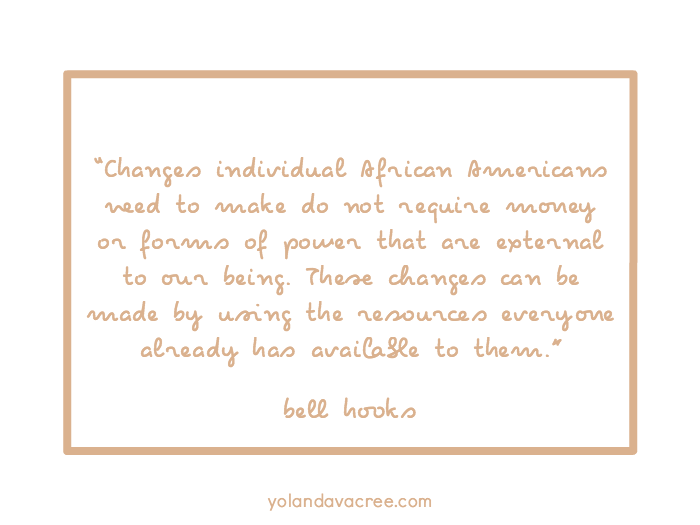
“Changes individual African Americans need to make do not require money or forms of power that are external to our being. These changes can be made by using the resources everyone already has available to them.” (206)
I have been saying this and I’ll keep saying it. This is a spiritual journey. I’m not just referring to minimalism, but our liberation too. The passion that we have for justice springs from so much pain. To be truly radical, we have to confront the pain of injustice and heal. It starts internally with each individual. Minimalism is a tool that can help us heal ourselves, our families, and our communities.
I encourage you to dig more into bell hooks’s work. She also has some great live discussions on Youtube. There is a lot to unpack and she provides a great foundation for understanding the political, spiritual, and socio-economic factors of our struggle for freedom and how simple living can liberate us.
Who has influenced your thinking on black minimalism? What other thought leaders should we check out?
Black Liberation Movements

Source: CreaterHer Stock
This is Part 3 of the Minimalism for Black Liberation series.
African resistance and the fight for liberation began many centuries ago in response to Arab and European encroachment. Early liberation movements were conducted via warfare and clandestine actions, but as time progresses the movements have adopted various tactics.
Before we can know where we're going, we must understand where we've been. In part three of the series, we're looking at the historical movements for black liberation. This list is not exhaustive and I've included two great resources at the end for you to further your knowledge.
Here are some of the major black liberation movements of the past 500 years.
Maroonage (1500s-1800s): Africans escaped to remote and uninhabited areas forming free communities in the Caribbean and the Americas.
Haitian Revolution (1791-1804): Armed revolt on the Caribbean island of Haiti which resulted in the first black independent country in that area.
Underground Railroad/Abolition (1700s-1800s): Clandestine network in the U.S. designed to guide escaping Africans to freedom in Northern U.S., Canada, and to a lesser extent, the Western U.S., Mexico, and the Caribbean. 1700s-1800s
Back to Africa/Repatriation (1800s): Thousands of Africans chose to return to the continent. Liberia and Freetown, Sierra Leone were established for those who willingly returned and were deported.
Pan-Africanism (1800s-1970s): Promoted unity among the continent and diaspora. Eight Pan-African Congresses have been held since 1900.
Civil Rights (1880s-1960s): Anti-lynching, desegregation and equal protection under the law.
Black Power (1960s-1980s): Right to self determination, self defense, and self respect. Black nationalism and unity were promoted.
African Independence (1847-1977): End American and European colonization of the continent.
Anti-Apartheid/Black Consciousness (1960-1994): End segregation in South Africa, recognize of civil rights including freedom of speech, and the promotion of black pride.
Black Lives Matter (2013- ): Combat police brutality and anti-black racism.
Additionally, there were a number of cultural and literary movements addressing the same ideals.
Freedom Narratives (1760-1909): Africans wrote autobiographical narratives of their lives and experiences in bondage.
Harlem Renaissance/New Negro (1917-1940s): Literary and artistic movement that asserted black creativity and identity.
Negritude (1930s-1940s): Literary movement influenced by the Harlem Renaissance. French Caribbean and African writes, also extended to Anglophone Caribbean artists.
Black Arts Movement (1965-1975): Focused on cultural nationalism and sister movement to Black Power. Art was created to encourage black consciousness and liberation.
It’s important to view the historical movements objectively. The pros include well-organized networks, clear objectives and agendas, direct action, and mass appeal. The cons include male-dominated leadership, class, gender and ethnic divisions, corruption and infiltration.
The Black Lives Matter movement demonstrates the pros of previous liberation movements while avoiding some of the cons. It was started by three women, is highly intersectional, utilizes the power of social media in conjunction with street protests and calculated disruption, and it is gaining international appeal in the diaspora.
What will the black minimalist movement look like?
That’s still to be determined. Minimalism for black liberation has already begun as an individual liberation movement. Minimalism is personal. It’s about our values, intentions, goals for our lives, and our willingness to focus on the essential. As we simplify and find clarity, we become examples to others in our families, communities, and other networks. Collective action can occur through education, community building, boycotts, and calculated political engagement.
Regardless of how we fight, we all have a part to play and there is space for multiple movements to occur simultaneously. In reviewing the approximate dates of the movements listed above, you can see many of them overlapped. Freedom fighters on the African continent and in the diaspora were influenced and inspired by each other to further the cause in their own communities and countries. A multi-front approach is a viable option for affecting change on a grander scale which transcends time and geography and can confront multiple issues.
In his book, Between the World and Me, Ta-Nehisi Coates makes an insightful point worth noting. Our ancestors who fought for liberation did so knowing it would probably not be realized in their lifetimes. In the conclusion, he entreats his son to struggle for the memory of his ancestors and for wisdom. Indeed, we do not fight for only ourselves. The work we do today is paid forward to our descendants and to those who struggle with us in spirit.
We must all do what we can for the struggle during our lifetimes, even if we only manage to achieve our own personal liberations. Each individual represents an aspect of the collective movement and if you inspire only one other person to pursue liberation, we have been successful.
The revolution starts with you and with me.
How do you envision the black minimalist movement?
Resources I used for historical synopses. They are great sources for an overview of the black experience.
http://exhibitions.nypl.org/africanaage
Ta-Nehisi Coates book:
Previous parts of the series:

6 Minimalist Principles for Black Liberation

This is part two of the Minimalism for Black Liberation series.
Read: Minimalism for Black Liberation: Intro
The major aim of the black liberation movement is for black people to have the right to self-determination. Self-determination is the right to control your own life. By extension, black liberation seeks the right for black people to control our communities, economically, politically, and culturally. Several principles of minimalism illustrate the effectiveness of a minimalist approach when applied to the liberation struggle.
1. We are enough.
We have to acknowledge that we are enough. We don’t have to be perceived as equal to other groups of people to affirm ourselves. The self-esteem of black folks needs to be considered as well as the role of mental health care in our communities. How we feel about ourselves individually and collectively is central to our liberation.
The emotional scars of racism, prejudice, internalized oppression and violence, mass incarceration, poverty, and police brutality, cannot be minimized. Our healing has to be a priority.
Healing also facilitates a mindset change. Liberation begins in the mind and education affects this change. We can not depend on the public education system to accurately teach our culture and history. Learning begins with each individual and we have unprecedented access to information in this time.
We also have to tell our stories. Whether we tell them to someone we trust, via art or performance, blogs or other formats, we have to share our experiences to heal and to learn from others.
2. Exist on our own terms.
This principle speaks to our need for self-sufficiency. The reality is that we don’t control our communities economically, politically, and in some cases, culturally. Gentrification has also taken its toll on urban communities.
In the late 19th and early 20th centuries, hundreds of black-owned communities were formed. Why did these communities disappear? Some were eroded by terrorism and racist zoning policies, while others were abandoned. Migration waves and integration also changed the face of many communities. but it doesn’t explain why we haven’t re-established our communities. Ironically, census data shows many young black americans are moving back to the south and residential segregation is still a reality all over America. Let's take advantage of the segregation to return to and build up our communities.
Increased political involvement at all levels is necessary with an understanding that it is only one part of process. To be counted and assert our priorities, we must show up and participate particularly at the local and state levels where we can see the efforts of our participation more immediately, but we will not rely solely on any government body to affect social change.
Entrepreneurship is on the rise among black folks, particularly in the digital world. Still, many communities lack black-owned businesses that cater to the basic needs of a community such as its food sources, health care, transportation, education, employment, and adequate housing. There is definitely a link between entrepreneurship and community-building. If we supply the needs and wants of our communities then wealth will remain in those communities longer.
3. Let go of what does not serve us.
There is no room for misogyny, sexism, ableism, homophobia, transphobia, classism, ethnocentrism, or any other oppression we heap on each other within our communities.
Divisiveness is not serving us. It’s ok to be critical of one another, but what are we doing to bridge the gaps of understanding? Can we accept constructive criticism as an attempt to uplift rather than attack?
Unhealthy habits need to be shed. We have to address the major health issues that disproportionately impact the black population. Additionally, we must deal with environmental impact of our habits and surroundings.
We can also let go of our savior complex. Expecting black leaders to live up to an idealized version of past leaders keeps us stuck. We do need to hold our leaders accountable, but recognize they are humans and fallible. We each have to accept responsibility of being leaders in our homes, families, and communities.
4. Make space for what matters.
We have to make space for each other. There's no such thing as being “too black” or “not black enough”. All black people don’t do this or do that. We are culturally diverse and highlighting our diversity is necessary for advancing our liberation.
It’s also important to welcome people who have been previously incarcerated back into our communities. They should have access to needed resources to become full participants in our communities and not relegated to the periphery or shamed for their past.
Let’s continue with our festivals, conferences, and traditions while creating new spaces for black folks to inhabit. We must continue to innovate, celebrate, and own our cultural and historical legacy.
The cultivation of safe spaces while protecting our communities from internal and external threats is integral to our ability to positively express ourselves culturally, economically, and politically.
5. Value things money cannot buy.
With integration and other national trends of the last 50 years, a large focus has been placed on financial and material gains. Black people proved they could be as valuable of consumers as the majority, but our quest for stuff has not led to social, economic, or political equality. Our focus on material gain has become a form of slavery itself.
Our relationships, dreams, experiences, and cultural legacies deserve prioritization over material things. We are not defined by what we have, but rather what we do to affect change at all levels.
6. Using resources responsibly.
Environmental, financial, and material resources must be managed properly in our communities.
This includes embracing green living including ways to reduce waste and preserve our natural resources. Also, improving our health and the environment by employing personal gardening, communal gardening, and supporting black farmers.
Additionally, promoting financial literacy, creating more thrift businesses and organizations to recycle and purchase affordable goods, and establishing more of our own banks, as well as benevolent and savings societies, will increase investment in our communities. Creating a financial culture of scholarship, charitable action, micro-loan networks, and venture capitalism will allow us to use our collective buying power of over one trillion dollars to redirect funds into our communities instead of into the hands of profiteering corporations.
If we are to leave a legacy for future generations we have to create diverse wealth generating systems that can be sustained and easily passed along.
"You don't need more time, you just need to decide." -Seth Godin
We must start where we are with what we have. If you've noticed, I haven't mentioned any idea that hasn't been proposed before. We already have the answers and the resources to secure our liberation for our selves and our communities. We just have to decide this is our mission.
Share your thoughts. Do you agree with the principles listed?
Minimalism for Black Liberation
Minimalism for Black Liberation is a series that explores the ways in which minimalism can be adapted in the struggle for black liberation.
The injustices committed against black people over the past several years have brought a renewed focus to the struggle for black liberation. Even after progress has been made in education, politics, financial security, and other areas, it's still rare to go a day without hearing about some racist BS whether it be through the personal stories of friends and family or via the media at large.
I've struggled to find a way to make sense of it all, sometimes it feels surreal to me that in 2015, with all the advancements the human race has made, racism is still alive and kicking. That's the thing about racism though, it's insidious. It doesn't matter how good a person you are, how much you've accomplished, whether you're law abiding, or you're a human being whose life deserves respect regardless, you're judged and acted upon based on perceived notions and hatred because of the color of your skin.
History has shown oppression and racism are here to stay for the time being, so what do we do? How can we rise above it and keep pressing forward? How can I affect the struggle for black liberation in a way that feels authentic? My answer to those questions is minimalism. It's a lifestyle I've adapted that has significantly changed my life and how I view the world, and I believe it's a possible solution for advancing our freedom as individuals and communities.
Black liberation is an ideology that supports the mental, emotional, socio-economic, socio-political, spiritual, and physical liberation of black people.
Black liberation encourages the resilience, creativity, intelligence, and strength of black people to create opportunities and solutions for our progress.
It seeks to neutralize the effects of racism as demonstrated through colonialism and neocolonialism, slavery, terrorism and genocide, capitalism, classism, sexism, authoritarianism, disenfranchisement, and other forms of oppression. It is not our responsibility to eradicate racism, but we will continue to expose it in all its forms.
Black liberation will only be achieved by us, when we accept the responsibility of freeing ourselves.
Black liberation like peace or happiness, is not a destination to be arrived at, but a lifelong journey. The struggle will continue as long as we exist.
The main purpose of this project is to introduce minimalism as a possible option for the achievement of black liberation. Minimalism works because it is a lifestyle and mindset change. We can not keep doing the same things and expect radical change to occur.
Minimalism is also viable because it encourages self-sufficiency, efficient and responsible use of resources, healthy living, and anti- consumerism and materialism. Minimalism encourages a break from societal and systemic norms.It works for individuals, families, and can work for our communities.
Minimalism is not a new concept or practice, although it has become more popular and trendy in the past several years.It can be summed up as living simply, be and doing more with less. Many peoples, including blacks, have lived this way throughout time and only recently, in the past 200 years or so, has that changed. It’s a part of our collective consciousness and we need to revisit and adapt minimalism to our current situation.
This series is going to explore the ways in which blacks can use minimalism as a tool to support our freedom and will serve as an overview. We will briefly examine the following: principles of black liberation and minimalism and how they intersect and compliment one another, historical and current black liberation groups to see what lessons can be learned and incorporated, and the current state of black America including economic, educational, political, and social measures and how minimalism can affect change in these areas.
Freedom ain’t free. What are you willing to give up to be free?