
What I Learned From The Philippines
I recently spent a month in the Philippines visiting my good friend Lani’s family. Now Lani last went home to PH in 2008 and when she came back, I told her I was going with her the next time. Little did I know it would be almost a decade later, but here we are. We traveled to Baclayan, Catbalogan, Tacloban, Bohol, Cebu, Batangas, and Manila, Philippines.

#PHILIPPINESTAUGHTME
I recently spent a month in the Philippines visiting my good friend Lani’s family. Now Lani last went home to PH in 2008 and when she came back, I told her I was going with her the next time. Little did I know it would be almost a decade later, but here we are. We traveled to Baclayan, Catbalogan, Tacloban, Bohol, Cebu, Batangas, and Manila, Philippines.
The path changes direction at any moment.
Just when you think you’ve got everything figured out, you’re comfortable, you’ve got your plan and you’re working on it, God says, “nope”. My trip to the Philippines was one big resounding “NOPE”. Randomly, one day in the midst of our Baclayan visit, doing absolutely nothing but shooting the breeze, a thought popped into my mind.
I could leave my life back home and live here. The thought shocked me and all of these questions followed:
Could I be far away from family and friends for a long time? Could I end or change my creative projects? Could I give up convenience of American life? Could I give up my favorite foods?
Could I take bucket baths daily? Could I deal with unstable internet? Could a boat replace my car? Could I survive typhoons?
Could I find a way to support myself financially? Could I be myself without coming off as disrespectful? Could I adapt to a culture that is very different from my own?
These thoughts let me know everything in life is transient. If you can imagine it and are willing to work for it, it’s possible. So, am I moving to the Philippines? I’ll let you know.
It’s possible to live even more simply.
My friend tried to warn me that things were very “simple” in the province and I think I was prepared for the most part. I probably should’ve downloaded more books before I left, but mostly I managed well.
Here’s the reality of the situation:
Black and brown outs. No microwaves or ovens. Rooster alarm clocks. Hand-washed clothes. Electric fans. Bucket baths disguised as showers. No running water at times...
I really came to understand the value of water. There was no water on demand unless it rained and we arrived at the beginning of the dry season. Otherwise someone had to go to the well or go to another island to get water. Drinking water had to bought or boiled. Since coming back, I’m definitely more conscious of my water consumption.
We ate some variation of the same foods everyday and it was good. There was no daylight savings time which I appreciated. No HBO NOW (#GoT) and the internet wasn’t strong enough to watch Netflix or even visit other sites besides Facebook.
We entertained ourselves by visiting people, taking walks, playing dominos and cards, drinking, swimming, drinking and swimming at the same time, karaoke, talking, reading, and sleeping. It’s hard to not be social, but you can find some time to be alone.
My life was very simple for 27 days and I loved it!
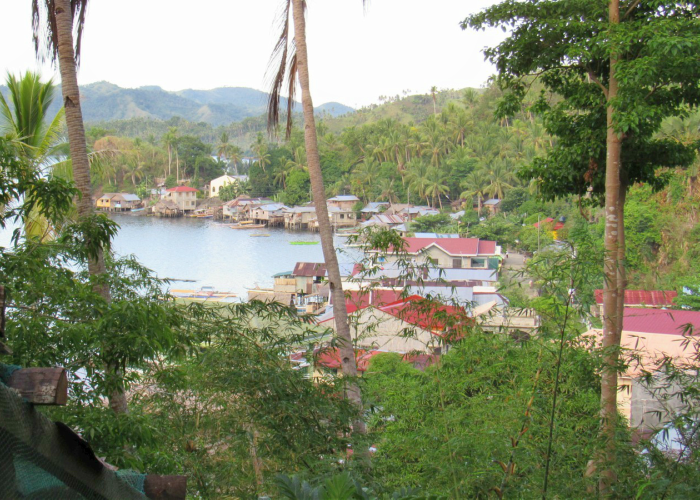
You can still be generous even when you have little.
Generosity is not just measured by how much money or things you can give. It’s also about a generosity of spirit. The ability to give your time and effort to someone.
I talked about the simplicity of life above, but I also have to be careful not to confuse simple with easy. It was humbling and a blessing to see how hard the family worked to provide for us and their own families. We were very well taken care of.
Additionally, I just saw people give and give. The selflessness displayed was inspiring and refreshing.
Respect is important.
This isn’t only a Filipino thing, but they do it very well. Respect is a deeply embedded cultural value that goes beyond what I can understand just from being there for a month. One simple way to show respect is how you address your elders and strangers. Nearly everyone has a title. For example, when speaking to or of an elder sibling, cousin, you say Ate (f) or Kuya (m).
Also, when you encounter your elders, you “mano” them. Mano is when you grab the person’s right hand and touch it to your forehead. You are asking the person to bless you. This gesture was very powerful to see coming from American culture. Mano-ing someone is asking them to honor you with their presence, experience, and wisdom.
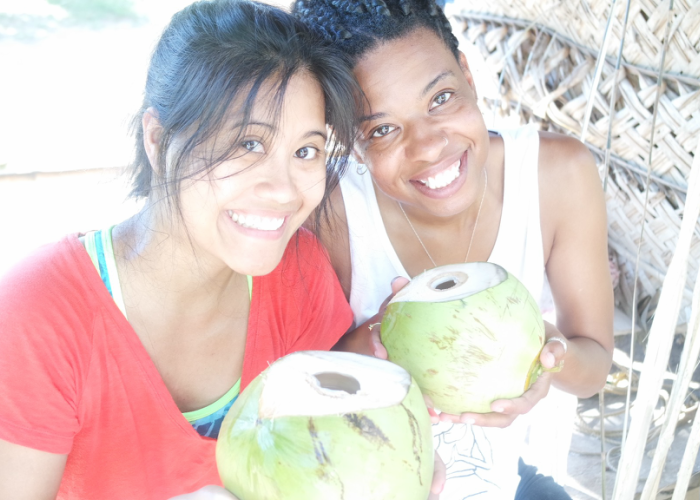
Your family will find you wherever you go.
I really didn’t know what to expect going on this trip. I travel for cultural experiences, but I’ve never lived with someone’s family. I’ve know Lani for over 10 years and have spent time with her stateside family throughout the years. Still, I wondered, “What would her family be like? Would we get along? Would they accept me? Is 30 days going to be too long? Would I offend them unintentionally?” I also may have been first black person to visit their village.
I needn’t have worried at all. Actually, I was not prepared for the amount of love and acceptance I received. I never felt like an outsider even though I didn’t know what they were saying half the time. I was told that I “fit” there was a blessing to hear. I gained a whole new family.
Unfortunately since my return, we lost a member of our family. On August 5th, Tita Jovie (below, center), the person who mainly took care of us while we were in Baclayan, passed away unexpectedly. In the wake of this tragedy, I have grown closer to my family there.

LIVE.
The last lesson I learned is this: STOP WAITING TO LIVE. You can’t stop change or the inevitability of death. Let go of everything that is holding you back and LIVE.
With my plans and God’s will, I’m going back to the Philippines. Something there is calling my spirit. Whatever is calling your spirit, go after it.
Want to see more of my Philippines trip? Watch:
What I Learned From Cuba
Lessons I Learned From Cuba
As I prepare to head to the Philippines next week, I'm feeling nostalgic about my first international trip, to the island of Cuba. I had the opportunity to visit Cuba in 2004. At the time, it seemed like a once in a life experience, but with relaxing relations between the U.S. and Cuba, Americans traveling to Cuba has become more popular in recent years. I thought I would revisit my time there and share what I’ve learned. Fortunately, I always keep a journal. I’ve kept hold of it for 12 years now, but perhaps after publishing this post, I will let it go.
Change is constant.
U.S. media has painted a portrait of Cuba as a place stuck in time, cut off from the outside world. Sure, there are many old, crumbling buildings and cars to be found in Cuba, but it is NOT stuck in the past. This wasn’t true even a decade ago. Not everyone in the world acknowledges the U.S. Embargo and many countries (Mexico, Canada, Brazil, Venezuela, China) trade with Cuba in all industries. It seems the only people who are stuck in the past about Cuba are Americans.
Nothing or no one is exempt from change. You either embrace it or be dragged by it into the next phase of your journey. For Cuba, that means normal-er relations with the U.S. that may open up avenues for partnership and also, exploitation.
I think one of the main critiques of these new relations is that Cuba will become America’s playground again like it was prior to the revolution. I don't think the Cuban government would allow that to happen again and it's unlikely major changes will occur while Fidel and Raul are still alive.

You will survive with less than expected.
The food at our hotel (Saint John in the Vedado neighborhood) and the restaurants in the surrounding neighborhoods was not that great. There were exceptions like the media noche sandwich we had at a small cafe up the street, the churros we ate for breakfast on our way to class sold by the fine churros man a few blocks over, and Coppelia, the largest ice cream parlor I’ve ever seen. I’ve heard the food selection is better now that paladares (restaurants in people’s private homes) are more prevalent, but we weren’t aware of them at the time of our visit.
I washed my clothes in our bathroom sink, which was fine because I only brought a rolling duffel bag with me in the first place. As I stated above, this was my first international trip and I was nervous about having my luggage lost or packing items that might be stolen, I didn’t want to pack a lot. I wasn’t even a minimalist then, but common sense told me to pack light.
I wore the same clothes over and over again, ate the same food over and over again, but it didn’t take away from the experience. It probably enhanced it because I was just open to whatever came. Leading me to my next lesson:
Cuba does minimalism well. It has too.
While Cuba is not stuck in the past it still has very limited resources. Cubans are industrious because it’s required for their survival. You don’t keep 50 year old cars running without recycling. Many things are saved for reuse later. I was able to give my leftover medicine, hygiene products, and other stuff I didn’t need to take back with me, away to someone in need I befriended while there. So while they don't necessarily get rid of lot of things, they efficiently use what they have and that's still minimalist.

There is no such thing as a post-racial society.
Not even Cuba could accomplish this, although Castro claimed the revolution eliminated racism (and classism) in Cuba. The racial and socio-economic stratification is apparent. The maids in our hotel, the attendant at Casas de las Americas, the prostitutes and homeless on our block, were black. When me and the other black girls went out to a dance hall, we were assumed to be prostitutes. We were followed and questioned by a police officer when we visited Cojimar Beach and asked to show our identification. Time and time again, Cuba reminded me being a black person, and specifically a black women, is not a privilege in this world.
Traveling with a group is not always the best option.
This was a study abroad trip sanctioned by a special license from the State Department, so traveling solo wasn’t an option. I had a few friends and classmates on the trip with me. Two things annoyed me the most: 1) People’s attitudes of entitlement and prejudice and 2) My friends not wanting to explore more during our free time.
I wish I could back in time and tell my 20 year old self to just go for it solo, but you live and learn. I didn’t feel confident or completely safe exploring the city alone at that time and was not interested in hanging out with some of other folks on the trip because of 1) above.
I haven't written off group experiences completely, but I don't plan on taking this type of guided trip again. I'll be traveling with a small group of friends to the Philippines who are Filipino and I'm hoping to have a more personal, immersive experience. I also plan to return to Cuba in the next year or two, and you better believe I'll be doing things my way.
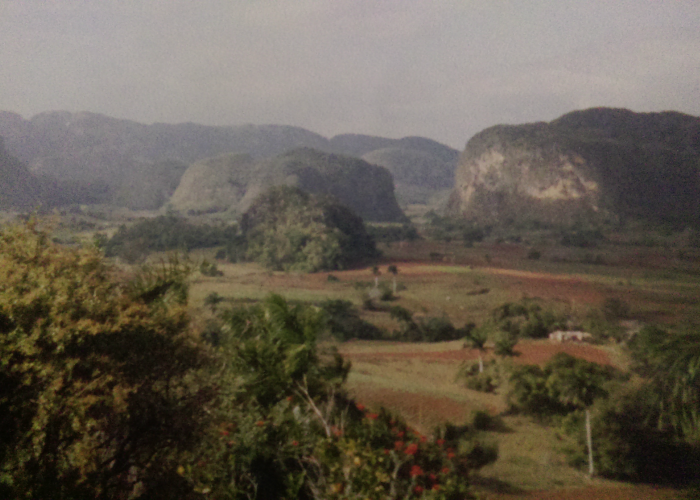
Walking is the best way to learn a place.
I didn’t get my license until I was 28 so I have a lot of experience with this. Even though my friends weren’t up for exploring as much as I wanted to, we still ventured out. You get to know the city intimately and discover hidden ways that can be overlooked when riding in a vehicle. It also forces you to develop a sense of direction. This trip was prior to cell phones with GPS and wifi capabilities. This lesson isn't really specific to Cuba, but it's important if you want a richer experience of any place you go to beyond the surface.
Cubans are everything.
Everyone says this and it doesn’t make it any less true. Geographically, Cuba is beautiful, but the scenery has nothing on the people. They are very attractive, intelligent, wise, hilarious, kind, and I could go on. In other words, they’re human.
There is a habit of exoticizing the people we encounter in other countries. Even culturally aware people do this from time to time. Re-reading my Cuban diary, I know I’m guilty of this. The truth is Cubans aren’t the first or last people to live under extreme austere conditions (see Iran, North Korea, and history in general). They have done what people do when faced with adversity, adapted and innovated. It doesn’t make them any less or more beautiful, intelligent, resourceful, or spirited than any other group of people.

I fell in love with Cuba because it was my first international travel experience. I have hyped the experience in my head and to others for a while now, but in recent years, I've been able to reflect on my visit to Cuba more critically.
On one hand, every place has its unique qualities, but on the other hand, it is what it is, and humans are humans everywhere. My goal with each travel experience is to continue to have an open mind, learn about the culture i'm embracing, live in the moment and then let the moment stand.
Happy traveling!
What I Learned From Mexico
I love traveling. I don’t do it as often as I would like to, but I’ve done it enough to know how beneficial it is.
Everyone needs a periodic disruption. Routines are a part of life, but when you get stuck in those routines you are prone to stress, burnout, jaded perspectives and lack of creativity.
Disrupting your daily routine removes the cobwebs and sweeps the dust out of the corners of your brain. It also challenges you to think differently about your daily existence.
I went to Mexico in July 2013 to break the routines, be inspired, to wander, and to simply be with no expectations or obligations. I also went to see what I could (re)learn about my life.
So what did my Mexican disruption teach me?
Don’t give into distractions.
A man screamed an obscenity at me.
Now to be honest, I have no idea what he said, but his intent was crystal clear.
It was around midnight and I had just gotten back from a bus trip to San Cristobal de las Casas. I was attempting to give my friend’s address to the taxi driver in my broken Spanish and he was not understanding or I was not understanding his responses.
I was tired from being on a bus for five hours, hungry and on my cycle. A man appeared at my window and started begging for money.
Ain’t nobody, me or the cabbie, have time for that.
All I wanted to do was get safely to Sylva’s house and lay my black ass down. I shook my head “no” and the taxi driver told also him “no”. I thought that was the end of it.
I turned back to the cabbie so we could continue our convo and then I hear the man yell something at me. I turned to look at him with a shocked and confused look on my face.
Whatever he said he was dead serious about it, but I couldn’t comprehend. My heart flashed with fear for a second, what if he tried to reach through the window and hit me?
The fear passed just as quickly as it came and I got back to the task at hand: getting to Sylva’s.
Lesson: I could’ve allowed myself to be offended and responded with some choice English words of my own, but I didn’t because I was focused on getting where I needed to be.
That’s what you have to remember when pursuing your goals and living in the present.
There will be a lot of distractions vying to pull you away from what you need to be doing.
You will have to choose if you’re going to react or stay focused. Acknowledge what will move you forward and ignore the rest, but If I see him in the streets again... it’s on!

Remember who you are.
I was racially profiled. How do I know that? I was the only black person on the bus and I was the only person the border patrol agent asked for identification.
I know this because I watched her walk the rest of the bus and turn around and she didn’t ask any other person for their documents.
Also, it wasn’t just because I was assumed to be a foreigner because there were other non-black foreigners on the bus as well. I kept calm because well, this is Mexico and shit happens.
I later found out this is not uncommon and she might have suspected me of carrying drugs, prostitution, or being an illegal immigrant. Understandable, but not.
Lesson: Prejudice, stereotypes, and racism are alive and kicking.
People will make negative (and positive) assumptions about you based on all types of things, some you may not even be aware of including their own experiences.
It is not your job to confirm or refute those assumptions. Your job is to remember who you are at the core of your being and live that authentically.
When she got on the bus, the agent's eyes focused on me immediately, so I knew what was up. When she asked for my papers I confidently handed them to her and looked her directly in the eyes when she asked me where I was from and what I was doing in Mexico and I told her the truth.

Take everything one step at a time, sometimes literally.
I climbed to the top of the Pyramid of the Sun. I went to Teotihuacan to see the Pyramids of the Sun and Moon and the Temple of Quetzacoatl.
The Sun pyramid ascends over 200 feet into the sky and has 248 steps. At first I was like nah, I’m not going all the way to the top. Then I said well maybe I’ll do a couple of levels.
As I would stop and take a break on the lower levels, I saw little kids, old people, and other people who didn’t look like they were going to make it, continuing to climb.
My ego knew I was not going to let them show me up. So I took a deep breath, a sip of water and got my tail on up there. Still stopping to take breaks and holding on firmly to the security rope, I did it!
The view alone was worth every step, sweat bead, deep/shallow breath and ache in my feet.
Lesson: Obstacles will arise in your life that look daunting and you can’t see any way over them or around them.
That’s ok. Whether you know what the result will be or not, all that’s required of you in that moment is to take the first step and keep taking one more step, until you reach the desired destination.
The thing that really got my ass into gear was knowing that I didn’t know when I would have another opportunity to climb the Pyramid of Sun and that leads me to my next lesson.
Take advantage of opportunities in the moment.
I don’t have a story for this lesson.
Don’t allow apathy, laziness, and stubbornness, all symptoms of fear, stop you from having a great experience or getting something you need.
There were several times when I said I would come back to this market or neighborhood another day to look around and I never did. Something else always came up.
I wish I had bought more silver jewelry in Taxco. I wish I had taken more time to explore the cities’ neighborhoods. I wish I had taken a ride on a trajinera in Xochimilco.
Lesson: It’s what you don’t do that you regret. Make memories rather than regrets. You will not live forever and second chances are not guaranteed. Seize the moment.

Education does not require a diploma or degree.
This is something I already knew and why I value my formal education, my life experiences have taught me the most.
Mexico offers a very good informal, but structured education. It's called a museum.
The thing that pleasantly surprised me was the number of museums in Mexico and particularly in Mexico City. Every subject has its own museum.
My favorite was the National Museum of Anthropology and History, but there were also museums about torture instruments, tequila, pop culture, jade and even the Corona factory had its own museum.
Lesson: Whether in a museum, a book, or on the internet, you can practically learn about anything that interests you so there are no excuses.
Being different is cool.
Let’s clarify a few things. I’m black. I have big natural hair. I’m taller than at least 75% of Mexicans (by my estimation).
The staring, the pointing, and the laughing were unnerving at first, but after a while, I learned to ignore it and even embrace it.
It was fun talking to strangers and watching people’s reactions to me. I received many compliments and I was interviewed a couple of times by university students.
Lesson: In a city of 20 million people (I forgot Mexico City was the second largest city in the world. It honestly had me shook for a minute.) and a world of 7 billion, it’s a good thing to be different.
I learned to trust my intuition more.
When I told people I was going to Mexico alone for three weeks, people thought I was crazy and were concerned for my safety.
The thought was a little scary for me too, but I knew if I didn’t take this opportunity I would regret it.
There were some situations where I had no clue what I supposed to do next or could not find the words to explain what I needed.
I made wrong turns attempting to navigate the streets or got off the bus too early or too late.
The miraculous thing is I always managed to find my way and end up where I needed to be.
Lesson: Intuition is not always about knowing exactly what to do next.
Intuition is about trusting that even if you make a wrong turn you will still arrive at the right destination.
It’s about picking out the one person in a crowd who can help you.
It’s about feeling safe and like you belong even when you’re surrounded by unfamiliar faces.
In life, it’s about having faith and knowing you are walking the path meant for you even when the world is telling you something different.
This last lesson was the most important to me because by trusting my intuition I am also more courageous.
I returned determined to figure out my business and take whatever risks necessary to make my dreams and goals a reality.
A year later my website is live, my message is clearer, I have done trainings to improve my entrepreneurial and life coaching skills, and I have more creative ideas flowing out of me.
Would I still be at this point if I hadn’t gone to Mexico? Maybe, but I don’t know and it doesn’t matter.
What matters is you live a life that is fulfilling to you and you do things that challenge you to grow.
What matters is you’re not afraid to be yourself in any situation and you’re willing to take risks.
What matters is that you’re open to adventures and you recognize the signs.
What matters is that you don’t accept less than the miraculous for your life.
Clear out the cobwebs, the dirt, and the fog and go do something that matters.